





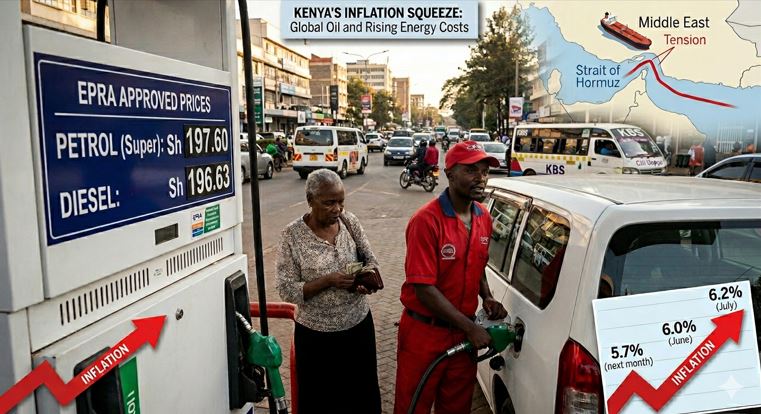
 Kenya’s inflation rate may climb toward the upper limit of the government’s target by mid-year as the Central Bank of Kenya (CBK) forecasts a steady rise fueled primarily by expensive energy.
The regulator expects headline inflation to hit 5.7% next month, climb to 6.0% in June, and reach a peak of approximately 6.2% in July. While officials anticipate a gradual decline toward the end of the year, the immediate outlook suggests a tighter squeeze on Kenyan pockets.
CBK Governor Kamau Thugge linked this revised forecast to global oil price shocks stemming from volatile geopolitical tensions in the Middle East. He warned that any extended disruptions would likely keep prices high in the near term.
“Assuming that the conflict lasts for the next three months, our inflation forecast goes above the midpoint of five per cent,” Thugge said.
This outlook mirrors recent fuel price shifts enacted by the Energy and Petroleum Regulatory Authority (EPRA). Under the most recent monthly cycle, petrol prices settled at Sh197.60 per liter while diesel reached Sh196.63, though kerosene costs remained static. Authorities believe these specific adjustments will eventually help temper the inflationary pressures currently weighing on the transport and manufacturing sectors.
The future of Kenya’s inflation hinges on international events, specifically the volatile tensions surrounding the Strait of Hormuz. As a vital artery for global oil transit, any disruption in this corridor triggers ripples across world markets, directly inflating the cost for Kenya to import petroleum products.
While the current landscape shows some resilience, with inflation holding steady at 4.4% in March 2026 compared to 4.3% in February, the Central Bank acknowledges that the trend is creeping upward. Despite this pressure from the energy sector, the regulator remains confident that the rate of inflation will stay within the government’s preferred range of 5±2.5% for the foreseeable future.
The bank credits this stability to a combination of proactive monetary policies and a steady shilling, which shields the local economy from the full brunt of imported price hikes. Additionally, favorable weather patterns continue to support consistent food production, keeping grocery prices manageable even as fuel costs climb.