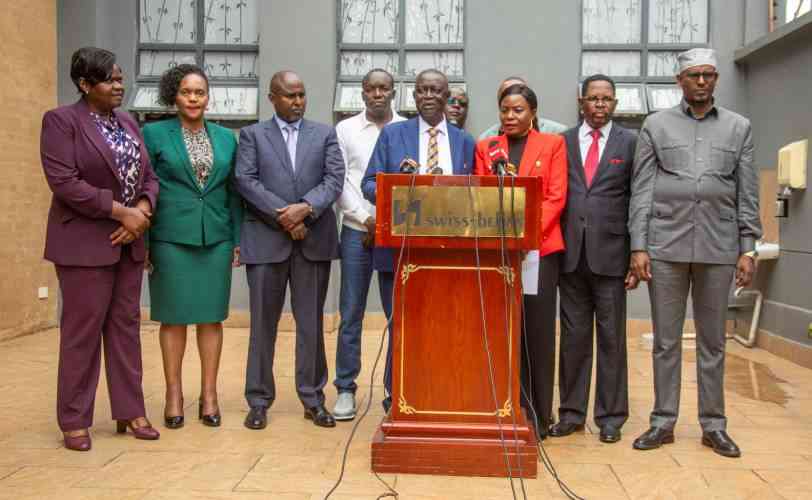





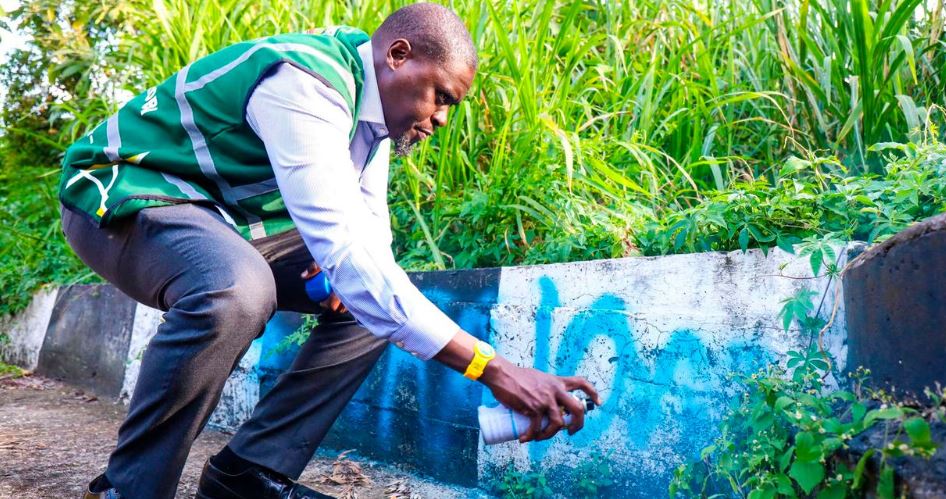

Nairobi Governor Johnson Sakaja has sent a stern warning to wealthy landowners in the city’s upscale estates after marking a section of the State House perimeter wall for demolition. Leading a multi-agency team from the Nairobi Rivers Commission, Sakaja revealed that President William Ruto personally authorized the removal of the wall, which currently blocks the Kirichwa Kubwa River and causes flooding during heavy rains.
The governor cited this high-profile move as proof that the government will no longer overlook illegal structures in high-end neighborhoods.
“This marked wall will go down. People should get ready and move from riparian land. If State House has been able to do this, everyone else should comply,” Governor Sakaja said.
He noted that the city is undergoing a major transformation to reclaim river corridors that have long been obstructed, a problem that has historically led to loss of life and property damage. While addressing the media during the marking exercise, the governor urged landowners along riverbanks to clear the riparian land voluntarily before the commission intervenes.
He vowed that the enforcement exercise would apply to everyone regardless of their social or political status. He acknowledged past criticisms that demolition efforts primarily targeted informal settlements downstream while sparing affluent areas.
“This exercise will not discriminate anyone. No one will be left behind. Previously, all the efforts were aimed at the areas downstream where we have informal settlements, and they kept asking, “What about Lavington? What about Westlands? What about Kileleshwa?” Today we are at State House. Everybody will be treated the same. There is no sacred cow on this operation, whether it’s an embassy, a church, or a disco,” he said.
The governor outlined a comprehensive plan to tackle Nairobi’s perennial flooding, highlighting the ongoing construction of a massive sewer line designed to serve the city’s population for the next half-century. Supported by a Sh50 billion budget, the multi-agency team aims to restore the river ecosystem, build pedestrian and cycling paths, and develop vibrant public spaces.
The team pointed to the successful reclamation of land along the Kibagare River near Westgate, now being transformed into a public park, as a blueprint for the city’s future.
“We are restoring the Nairobi River, creating walkways, reclaiming riparian land, and transforming the city. The walkways will serve as transport corridors where people can walk or cycle safely, with lighting and security,” Governor Sakaja said.
Governor Sakaja hinted that even close friends have contacted his office seeking protection from the looming demolitions, but he maintained that no such favors will be granted.
Water Resources Authority (WRA) CEO Mohamed Moulid Shurie, a key member of the team, echoed this commitment to fairness and legal precision. He invited anyone who disputes the technical measurements to lodge a formal complaint, promising that the process will strictly obey the law.
“We are going to be fair with everybody in this country because the law is there. We cannot make any mistakes, and if there is any wrongdoing with the measurement, you can come and complain,” Shurie stated.
The CEO praised President Ruto for setting the standard by allowing the marking of State House property, warning that anyone who has encroached on riparian land is now on notice.
“If we are doing this at State House, what about you? We are doing something which is within the law, something which is good for everybody.”