

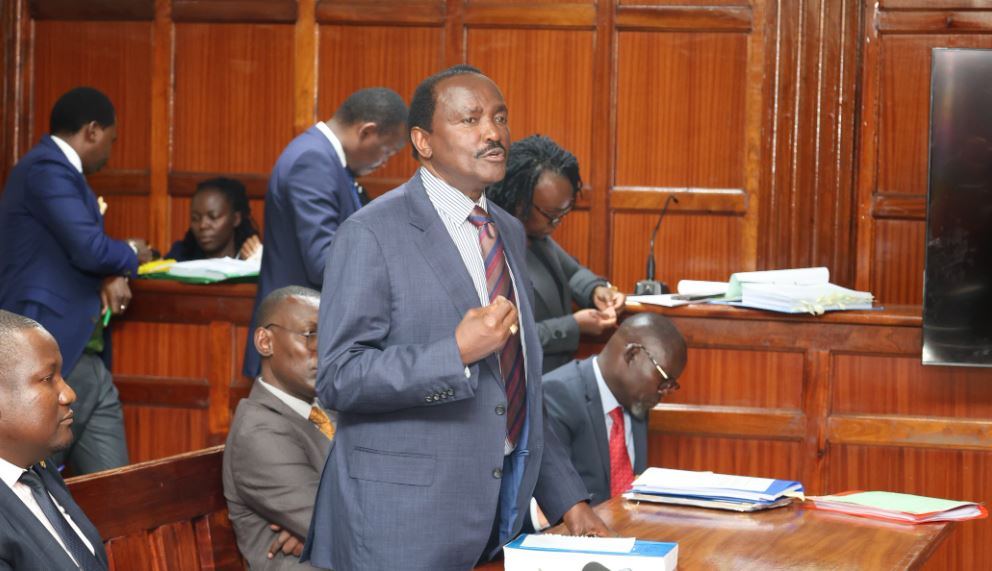
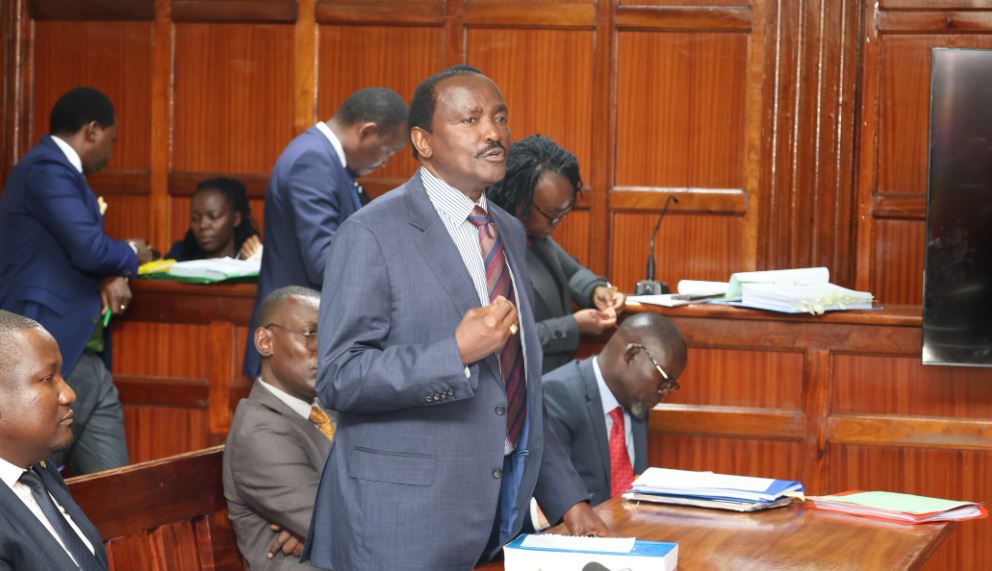
 Senior Counsel Kalonzo Musyoka has petitioned the High Court to extend conservatory orders blocking the government’s proposed sale of a 15 percent stake in Safaricom. Addressing a three-judge bench on Thursday, Musyoka described the telecommunications giant as a vital national asset that the court must protect until all constitutional challenges are resolved.
“Safaricom happens to be the goose that lays the golden egg, contributing significantly to GDP of our economy,” he submitted, highlighting the company’s central role in Kenya’s economic landscape. He pointed to Safaricom’s massive scale and cross-sector influence as reasons to halt the divestiture.
The Wiper party leader argued that the push for the share sale has already gained significant momentum within state institutions. He noted that the National Assembly issued an approval effective April 1 to proceed with the transaction, which involves offloading the 15 percent stake to a foreign entity. Given this legislative backing, Musyoka insisted that judicial intervention is necessary to prevent the sale of the subject matter of the petition before the court can fully hear the case.
Musyoka warned that allowing the divestiture to proceed would effectively render the legal challenge meaningless, noting that if the conservatory orders are lifted, the remaining proceedings would become merely “academic.” He urged the court to maintain the status quo until the dispute undergoes a full hearing.
The case has now moved before a three-judge bench, empaneled by Chief Justice Martha Koome, to handle multiple petitions challenging the legality of the sale. At the heart of the current proceedings is a directive from Justice Lawrence Mugambi, who previously ordered that the status quo be preserved until the bench was fully constituted.
Kalonzo underscored that Safaricom represents more than just a private commercial entity; it is a strategic pillar of the nation. To illustrate its global significance, he pointed to the international success of M-Pesa.
“The world has taken note. The name M-Pesa, a Kenyan invention, has hit international space,” he said, citing the mobile money platform as proof of Safaricom’s unique value. He further noted that the company’s extensive economic footprint supports the livelihoods of millions of Kenyans, making its preservation a matter of intense public interest.
Kalonzo argued that the company’s influence extends far beyond commerce, touching the very fabric of national development and financial inclusion. The legal battle pits Musyoka against the Attorney General, Safaricom, and other state agencies.
John Ohaga, representing one of the respondents, challenged the legal basis for extending the pause on the sale. He argued that Justice Mugambi had only issued a temporary “status quo” direction to bridge the gap while the bench was being formed, rather than a full conservatory order.
“Orders of status quo cannot supplant conservatory orders. They are not a replacement,” Ohaga contended, stating that the previous directive has now expired and only the newly formed bench can decide on a fresh extension. He noted that while an application for conservatory orders exists, the court should only determine its merit during a substantive hearing rather than rushing to a conclusion while the case is still developing.
The lawyer further dismissed the idea that the petitioners speak for the entire nation, stating, “There are four petitioners. They should not flatter themselves; they represent 40 million Kenyans.”
He maintained that there is currently no evidence that Parliament acted unlawfully and rejected claims that Vodafone Kenya is a foreign entity.
The High Court has extended orders blocking the government from offloading its 15% stake in Safaricom, a move that currently freezes a transaction valued at over Ksh204 billion. The three-judge bench, consisting of Justices Francis Gikonyo, Tabitha Ouya Wanyama, and Roselyne Aburili, ruled that the freeze will remain in place until April 27, 2026.
The judges determined that maintaining the status quo is essential to protect the integrity of the case while the court prepares to hear an application to extend these orders until a final verdict is reached.
The bench ordered all parties to file and exchange their legal responses within seven days to ensure the case remains on track. They scheduled a critical hearing for April 27, 2026, specifically to weigh the request for a longer extension of the current freeze on the share sale.
“The court will hear the application seeking to extend the interim orders on April 27, 2026,” the judges ruled.
The court also gave the petitioners permission to refine their arguments by amending the petition within the next week. This procedural window allows the challengers to sharpen their constitutional claims against the National Treasury before the bench reconvenes to decide whether to keep the multi-billion shilling transaction on hold indefinitely.