



President William Ruto has declared that the regeneration of Nairobi is now in full swing, with major improvements in street lighting, road networks, and waste management starting to reshape the capital.
To improve the city’s infrastructure, the president announced a massive project to build and upgrade 250 km of roads across all neighborhoods, including informal settlements. Construction is already underway on 67 km, with another 70 km set to begin shortly.
The president also highlighted the city’s transition into a vibrant 24-hour economy, which he believes requires a robust supporting infrastructure. To facilitate this, the government is installing 40,000 new lights along roads and within residential estates.
“We are also putting up 40,000 lights on roads and in estates. This is a 24-hour economy city, and we have to implement this important infrastructure,” he said.
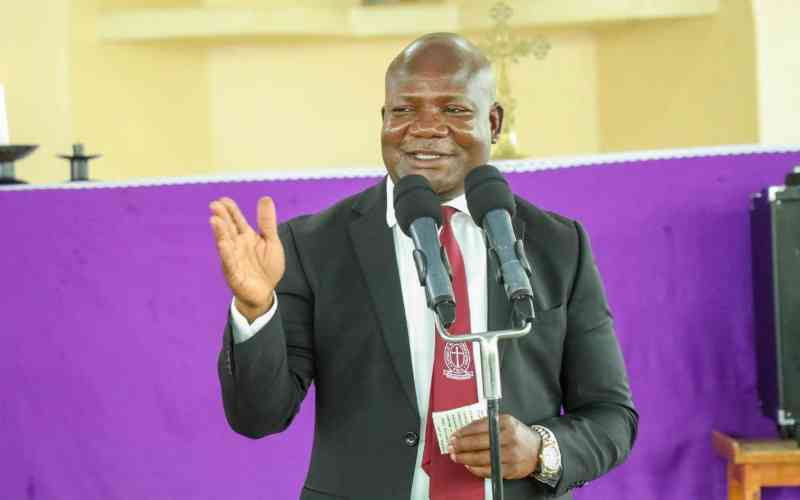
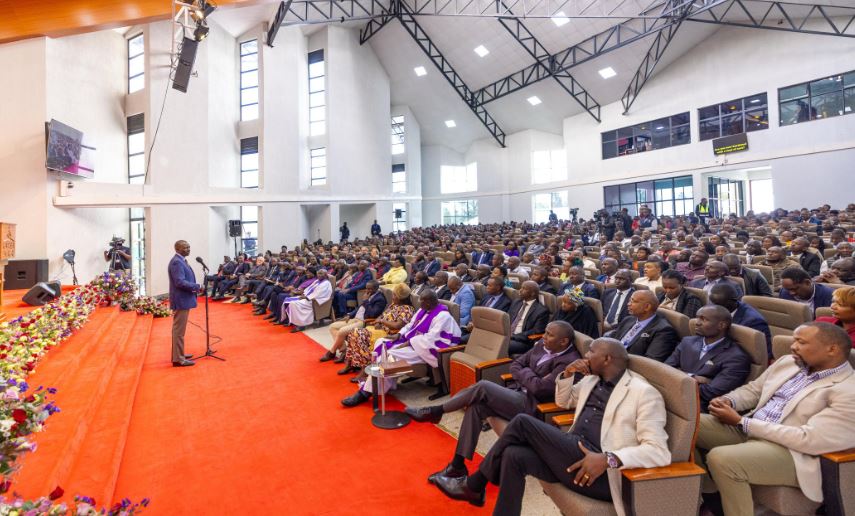
Addressing the long-standing challenge of waste management, President Ruto noted that garbage collection has significantly improved following the deployment of 40 new trucks last week. He shared these updates during a Sunday service at the African Gospel Church (AGC) in Karen, where he also presided over the opening of the church’s new head office, the AGC Tenwek Hospital Nairobi Clinic, and the Karen AGC Sanctuary.
The president expressed his commitment to a cleaner capital, outlining plans to expand the waste collection fleet to 150 trucks and eventually to 250. He vowed to sustain these efforts until the city is completely clear of refuse.
“The number of trucks will be increased to 150 and eventually to 250,” he said. “By December, Nairobi will be different.”
Regarding the health sector, President Ruto announced that the Social Health Authority (SHA) will release KSh 13 billion this week to settle hospital bills for services rendered in March 2026. This funding will be drawn from a combination of the Primary Health Care Fund, the Social Health Insurance Fund, and the Emergency, Chronic, and Critical Illnesses Fund.
The president described the transition to universal healthcare as a tangible reality, pointing to significant progress in how the system handles resources.
“The money we are paying under SHA in one month is equivalent to the sum that used to be collected in six months under the defunct National Health Insurance Fund (NHIF),” he said. “This is the difference we are making.”
President Ruto stated that his administration has remained intentional and deliberate in reorganizing the nation’s healthcare framework from the very start. He reflected on the long history of the policy, noting that while previous administrations, including the Jubilee government in which he served, debated universal health coverage for years, those efforts failed to cross the finish line.
“Universal health coverage was discussed during the Narc administration. We talked about it in the Jubilee administration, which I was part of,” the President said. “But three years after we came into office, universal healthcare is becoming a reality.”
The President explained that the Social Health Authority (SHA) does more than just expand healthcare access; the new system has effectively dismantled the networks that once exploited the inefficiencies of the NHIF. He noted that the transition to a digital platform has streamlined operations, making the entire process more transparent.
“SHA has been paying bills promptly. You don’t have to make any telephone calls for your bills to be paid,” President Ruto said. “We have digitised health processes, eliminating manual paperwork.”
President Ruto identified the Africa Gospel Church as a vital ally in this national transformation, praising its contributions through its health and education wings. He expressed his gratitude to the church for supporting the constitutional mandate to provide quality healthcare to every Kenyan.
“I want to thank the church for helping us in our objective to make health accessible to all, a right stipulated in Article 43 of the Constitution,” he said.
Addressing the criticism surrounding these reforms, the president urged the public to dismiss the claims of vocal opponents. He argued that many critics were simply the beneficiaries of the corruption that previously drained the NHIF.
“The naysayers criticise us because they have lost due to the reforms we have instituted. Some facilities were doing more billing than treating patients under the previous system,” President Ruto said.