





Aflatoxin has been described as a major food safety crisis in Kenya, with endemic contamination reportedly affecting key staple crops such as maize, peanuts, and dairy products, mostly in the eastern region.
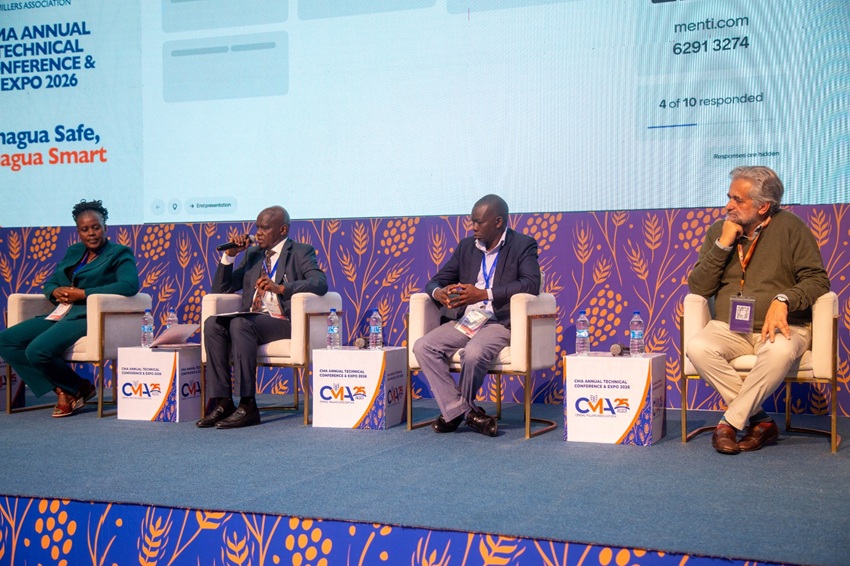
The aflatoxin crisis featured prominently during the annual Cereals Millers Association (CMA) Technical Conference and Expo 2026, organized by CMA. The two-day event, held at the Sarit Expo Centre in Nairobi, brought together over 70 companies—including those offering solutions to aflatoxin—and millers.
While exhibitors termed it a crisis that deserves action to end it, one company, Aflabox Srl, came with a solution for aflatoxin in Kenya—the first of its kind in Africa. The company developed Aflabox, a tool that uses AI to scan and provide real-time aflatoxin testing from the ground.
Paloma Fernandes, Chief Executive Officer of the Cereal Millers Association (CMA), said Kenya has had a serious problem with aflatoxin for many years, and action is being taken to find out how the entire problem can be addressed. Top among these efforts is the innovation of Aflabox by an Italian company, which has brought solutions to the crisis.
Speaking during the Annual Technical Conference and Expo 2026, the CMA CEO said that in 2012, statistics showed that 65 percent of commercial flour on store shelves had been contaminated by aflatoxin.
“This affected milk as well as breast milk and peanuts. We then started self-regulating. Somewhere in 2020 we found that about 50 percent was still contaminated,” she said.
She said in 2020 there were also some aflatoxin cases that could kill instantly, but revealed that they have been working to sort that out.
Fernandes said they were very excited that this year’s conference included new innovations in terms of aflatoxin testing and fortification.
“One of the exciting ones, as you have seen, is the Aflabox, and this is going to be a game changer for us—whether we are in mills, on the farms, or as aggregators. We are very excited to see where this innovation will take us,” she said.
Dr. Luca Alinovi, CEO and Co-Founder of Aflabox, said his startup is bringing new technology to measure aflatoxin in a country where things are complicated.
He said their innovation uses the Aflabox connected to Wi-Fi to test for aflatoxin instead of using complicated labs.
“Instead of using bio-chemicals, you just put our device, do a click, and in 30, 40, 50, 60 seconds you get the results—if it’s contaminated or not,” he said.
Alinovi said Aflabox is going to change the lives of millers, traders, and farmers who are often exposed to the big problem of aflatoxin.
He said CMA has been the champion against aflatoxin, adding that the government has also been very aggressive against aflatoxin, and he felt they were fighting the same battle to end the crisis.
“Aflabox is a European company but is represented here by Aflazero, which is allowing us to be present and to work extensively in the country. We want to be very big and solve the problem for the people—the millers, the traders, and the government,” he said.
Alessio Collussi, an agronomist at Aflabox, said the big problem Kenya and the whole of Africa is facing is the amount of aflatoxin present in the food being consumed daily, particularly food made from flour.
He said many times it has been found that the amount of aflatoxin is very high, exceeding the legal limit.
“The legal limit in Kenya is 10 ppb. Now the issue is that to measure aflatoxin in food, we require equipped laboratories where laser tests or other sophisticated analyses have to be performed. So in this case, what we wanted to do was to prepare a solution that would simplify the screening of aflatoxin,” he said.
Collussi said they came up with a small box where a sample of maize is added to conduct tests, enabling farmers, traders, or aggregators to understand the origin of risks and be able to solve the problem.
Dr. Wilson Songa from Kaizen Top Mark and a member of the Executive Board of the Agriculture Sector Network said Aflabox would change the infection of aflatoxin and ensure action is taken in time to prevent contamination in food.