



Newspapers on Tuesday, April 20, covered various topics, including the increasing pressure on President William Ruto in relation to the prices of fuel products.
1. Daily Nation
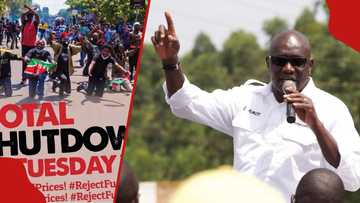
The newspaper reported about the former Deputy President Rigathi Gachagua warning President William Ruto that the opposition is ready to organize street protests due to the rise in fuel prices.
The leader of the Democracy for Citizens’ Party (DCP) said he is closely monitoring the deteriorating cost of living in the country.
Gachagua warned that if the situation does not improve, he will organize a national protest next week together with other pressure groups.
He claimed that the price of oil could be reduced by at least half if the government abandons “trade agreements that benefit the few” and instead prioritizes ordinary citizens over “international traffickers.”
Speaking on a local news channel, Gachagua gave Ruto a notice to cancel the government-to-government (G2G) fuel procurement program and remove the Value Added Tax (VAT) on petrol products, stressing that the move would protect consumers from price shocks.
Also read
Ekuru Aukot urges Kenyans to come forward to argue about oil prices: “Let us drink teargas”
The former Vice President also demanded a review of the securitization program, saying that the funds intended for the development of the oil sector have already been tied up to pay loans.
“Seven shillings that the government collects as fuel tax per liter have already been directed to pay the loan. Those are the funds that should have helped consumers through subsidies. What we have is a poorly managed sector where government officials have turned it into part of incomprehensible deals,” he said.
“There is no real government-to-government plan for the purchase of oil because the whole plan is full of personal interests of the few,” he added.
Gachagua warned that failure to establish a reliable system to compare oil prices with the international market could fuel public unrest.
He recalled the recent riots in Kenya, citing the protests by Gen Z youths that occurred after the June 2024 Finance Bill.
“We are rational people. The leaders of the Opposition will give guidance on how our supporters will cooperate with the government. President Ruto has a choice… do what is necessary and avoid a major crisis or ignore it and face the consequences. Do not think that there will not be a repeat of the Gen Z event of June 2024, especially as we approach its second anniversary,” he said.

He asked the government to stop playing with the problems of the people.
“They are making ridiculous statements that do not match the seriousness of this issue. We are not doing politics, we are telling the government that it cannot wake up, increase the price of fuel by KSh 40 and then later announce a reduction of KSh 9 and expect to be praised, while there is still an increase of KSh 31,” he said.
The former Mathira Member of Parliament also accused Ruto of abandoning the principles he had when he was Deputy President under Uhuru Kenyatta.
At the same time, Gachagua criticized the government for claiming that Kenya has fully entered the middle income economy.
2. Nation Today
This newspaper focused on the politics of Mount Kenya as the main presidential candidates seek support in the area for next year’s elections.
Ruto has now embarked on a new strategy to seek support in Mt Kenya, saying he will “repay the favor” in 2032 by supporting his deputy. Kithur Kindiki.
This comes after the president lost support in the area where he got 87 percent of the vote in 2022.

The main source of his problems is the removal from power of former Deputy President Rigathi Gachagua in October 2024.
After his removal, Gachagua has continued to be a challenge to Ruto after establishing the DCP party and leading a rebellion against the president in the Mt Kenya area.
After his removal, Gachagua has strengthened his political empire in the region and painted Ruto as an enemy of the Mount Kenya community.
The president’s efforts to maintain his popularity in the region have not been fruitful, while his close advisers are devising new strategies to save the situation.
These challenges have led the deputy president to be seen as Ruto’s successor in the 2032 general election.
The president, Kindiki and some of their allies have been showing that Kindiki is being prepared to become president in 2032.
While on a visit to Kisii County, Ruto said Gachagua is impatient, which contributed to his removal from power.
“If you don’t have the patience to be led, then you don’t deserve to lead,” he said, a statement that shows the politics of the 2032 legacy.
Kapseret Member of Parliament Oscar Sudi, a close ally of the president, recently said the only way for Mount Kenya to return to the White House is through political cooperation between Ruto and Kindiki.

“The President does not hide that he is a product of Mt. Kenya and he would like to cooperate with the region now and in the future to unite the country. Members of Parliament who show patience, honesty and hard work succeed, and Professor Kindiki is one of them,” said Sudi.
On his part, Kindiki has clearly stated that his loyalty to President Ruto is a political strategy due to his closeness to the presidency.
3. The Standard
With schools expected to open for the second term on April 27, the National Road Safety Authority (NTSA) has issued new safety advice to institutions.
The guide, part of the #WatotoWafikeSalama campaign, emphasizes the government’s policy on student transport and warns against carelessness that can endanger lives.
It comes at a time when thousands of students are preparing to go back to school, a time when there is heavy traffic and an increase in accidents involving students.
“As schools prepare to open, all school administrators are encouraged to ensure their vehicles are safe on the road and comply with regulations,” NTSA said in a public statement.
The school transport system in Kenya is governed by road safety laws, education guidelines and NTSA regulations aimed at protecting students, who are the most vulnerable road users.

Cars must be registered, inspected, and equipped with safety equipment such as seat belts and cruise control, while school buses must have clear identification signs.
Drivers must have a license, be in good health, and have the qualifications required for the type of license in question, as well as regular inspections to confirm ability and discipline.
Regular inspections are mandatory, with the NTSA and traffic police conducting surprise inspections especially during school opening periods.
The latest guidelines list eight factors covering vehicle conditions, driver characteristics, traffic compliance, and traffic management.
The NTSA stressed that vehicles must be properly maintained to avoid mechanical faults, and speed controls should be working properly.
Driver behavior was cited as a major challenge, with NTSA warning against the use of alcohol or drugs, fatigue, and unauthorized lane changes.
Schools should ensure vehicles follow approved routes at all times. Institutions that violate the safety rules will be taken action, including the suspension or cancellation of the license.
These enforcement actions follow a series of fatal school bus accidents in recent years, prompting public concern and calls for accountability.

The second semester often sees more travel due to boarding students returning to school and extracurricular activities, thus increasing the risk of accidents.
Education stakeholders have been encouraged to be careful, especially in private transportation plans. NTSA has confirmed that it will increase inspections during the opening of schools, in collaboration with the traffic police.
The Chairman of the National Association of Parents, Silas Obuhatsa, urged parents to ensure that transport safety standards are observed, stressing that the observance is a legal and moral obligation to protect students.
Source: TUKO.co.ke