



 The Ethics and Anti-Corruption Commission (EACC) released the Kenya National Gender and Corruption Survey 2025, uncovering a complex web of gender and marital dynamics within the country’s bribery culture. Released on Thursday, April 9, the findings indicate that women and single individuals pay bribes more frequently than their male or married counterparts when interacting with public services.
The data highlights a distinct gender divide in the types of officials targeted for these payments. Over the 12 months leading up to the study, female respondents reported paying bribes 10 or more times primarily to tax and revenue officers (19.8 percent), immigration officials (12.7 percent), and various health workers (6.7 percent). These figures suggest that women may face more frequent demands for “facilitation fees” in administrative and healthcare settings.
Men, meanwhile, interact with a different set of agencies when engaging in corrupt practices. Male respondents most frequently bribed officers from the National Transport and Safety Authority (12.6 percent) and the National Police Service (10.9 percent). They also reported paying bribes to teachers and lecturers in public institutions at a rate of 4.0 percent, reflecting a corruption landscape heavily tied to the transport and education sectors for male service seekers.
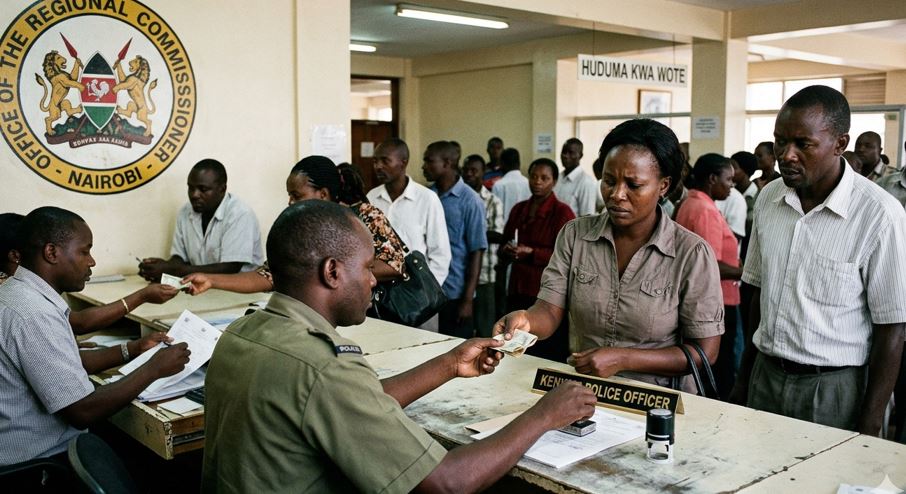
Marital status also plays a surprising role in how citizens navigate the corruption landscape. The EACC study shows that single individuals most often pay bribes to civil registration officials (45 percent) and the police (43.9 percent). For those in monogamous marriages, the trend remains similar but at slightly lower rates, with 37.7 percent paying off police and 30.8 percent bribing registration staff.
The data shifts significantly for other groups. Respondents in polygamous marriages reported a high frequency of bribery involving both immigration and police officers, both at 41.3 percent. Divorced individuals reported an overwhelming trend, with 72.9 percent paying bribes to officials at the National Transport and Safety Authority (NTSA). Meanwhile, widows primarily directed their payments toward civil registration officials (28.3 percent) and NTSA staff.
Financial status reveals perhaps the most startling disparity in the report. Low-income Kenyans, earning less than Ksh10,000, face extreme pressure; the survey found that every single respondent in this bracket who interacted with a judge reported paying a bribe. This group also paid bribes at remarkably high rates to civil registration officials (87.2 percent) and immigration officers (86.6 percent).
In contrast, high-income earners – those making over Ksh100,000 – tend to encounter corruption in different arenas. Their payments mostly target land registry officers, tax and revenue officials, and registration of persons staff. Notably, this wealthier bracket also reported paying bribes to Members of Parliament, suggesting that higher financial stakes often lead to corruption within more influential levels of government.
The National Police Service maintains the highest overall prevalence of bribery at 35.5 percent, followed by civil registration officials at 30.0 percent. The survey identifies the National Transport and Safety Authority (NTSA) at 25.4 percent and land registry officers at 23.3 percent as other high-risk areas. While some sectors see more frequent bribes, the financial scale varies wildly; magistrates collect the largest average cash bribe at Ksh164,367, whereas civil registration officials receive the smallest average payment at Ksh1,415.
Gender dynamics within the public service also play a significant role in these interactions. The report reveals that male officers overwhelmingly dominate the sectors most frequently implicated in corruption. Specifically, men make up 92.9 percent of the NTSA workforce, 92.3 percent of prosecutors, 90.9 percent of public utility staff, and 88.8 percent of the police force.
Conversely, the survey found that women are more likely to pay frequent bribes to tax and revenue officers, immigration officials, and healthcare workers. This pattern suggests that women encounter more corruption while navigating essential services and trade-related administrative tasks. These findings paint a detailed picture of how gender and institutional makeup influence the flow of illicit payments across the country’s public offices.
Beyond financial extortion, the survey uncovers a disturbing trend of sexual exploitation within public service delivery. The findings indicate that 8.4 percent of Kenyans have encountered indirect requests for sexual favors, a burden that falls more heavily on women at 9.3 percent compared to 7.4 percent for men. The disparity becomes even more pronounced with direct requests; while 2.1 percent of all respondents faced such demands, women encountered them at a rate of 3.4 percent – more than four times the 0.8 percent reported by men. Young adults between the ages of 18 and 34 face the highest risk, particularly when they are seeking employment or urgent medical care.
Despite the pressure to comply with corrupt demands, a significant majority of Kenyans choose to resist. The data shows that many citizens refuse to pay bribes to male public officials, with the highest rates of defiance directed at prosecutors (89.9 percent), police officers (89.6 percent), and members of parliament (89.6 percent). This widespread refusal suggests a growing public pushback against entrenched graft, even in high-pressure situations involving law enforcement and the justice system.
The report concludes that women remain more vulnerable to frequent bribe requests because they typically manage the household’s interactions with essential services. Because women often take the lead in securing family needs, they find themselves on the front lines of administrative corruption more often than men.
A Nairobi-based focus group highlighted this systemic inequality, noting that “Corruption affects women more than men. When corruption comes into play, the people who engage in the negotiations, the bribes, or the deals are mostly men.”