


 President William Ruto has pledged to lead by example by ordering the demolition of a section of the State House perimeter wall that encroaches on protected riparian land.
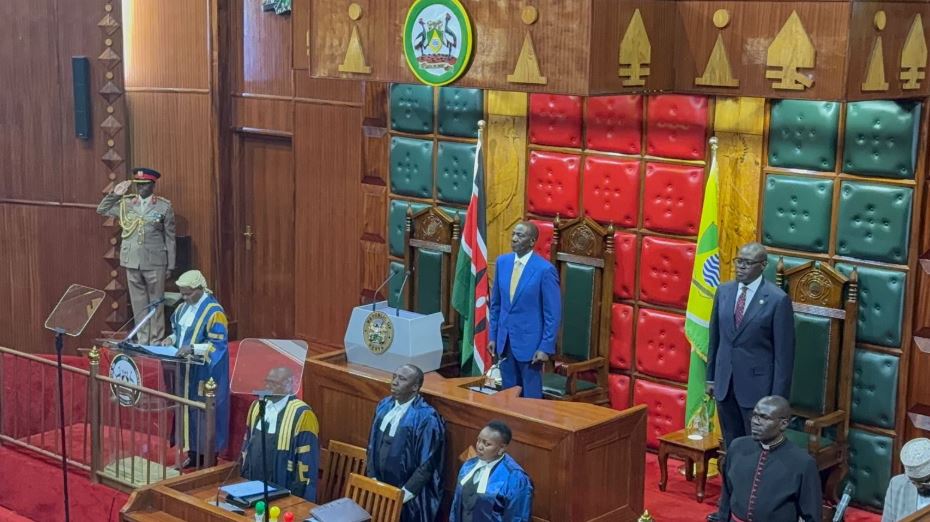
Addressing the Nairobi County Assembly on Thursday, April 9, 2026, the President revealed that he had received a formal notice indicating that the boundary wall along the Kirichwa Kubwa River violates urban planning and environmental regulations.
“State House has received a notice that part of the State House boundary wall along the Kirichwa Kubwa River falls within the riparian reserve. And it must come down,” Ruto told the MCAs. He confirmed that the directive requires a 15-meter setback from the river’s high-water mark, vowing, “I promise you that wall will come down.”
The President’s decision follows a confidential letter dated April 7, 2026, from the Nairobi Rivers Commission to State House Comptroller Katoo Ole Metito. The letter, signed by CEO Brig. (Rtd) Joseph Muracia, detailed findings from a multi-agency inspection that concluded that the southwestern boundary wall encroaches into the riparian zone by 10 to 15 meters.
By targeting his own official residence, Ruto sought to send a clear message that no individual or institution is above the law in his administration’s quest to restore order to the capital. He warned that “cartels and brokers” profiting from illegal constructions and broken systems would face similar consequences as the government intensifies its river rehabilitation efforts.
“If illegal structures must come down, they will come down,” he insisted. “And if systems must be reorganized to restore order, they will be reorganized.”
To facilitate the restoration, Brig. (Rtd) Joseph Muracia has formally requested access to the protected State House grounds to allow the multi-agency team to officially demarcate the riparian zone. Once this boundary is established, State House will be required to adjust the wall to align with the legal 15-meter setback.
The letter to the State House Comptroller was clear about the necessity of this step:
“The Multi-Agency team wishes to access the grounds… to properly demarcate the riparian zone. Thereafter, you will be requested to adjust the wall in compliance with the demarcation notice.”
President Ruto used the occasion to call for a new era of urban discipline, framing the demolition as a sacrifice for the greater good of Nairobi’s future. He argued that the transformation of the capital into a world-class city depends on leaders choosing “discipline over disorder” and “public interest over private convenience.”
By emphasizing that even the highest office in the land must respect regulations regarding water, sanitation, and green spaces, the President signaled that the days of short-term political interference in urban planning are over. He maintained that a serious city must guarantee a dignified environment, which starts with protecting its natural resources and waterways.
“The great cities of the world became great because leaders chose discipline over disorder, long-term planning over short-term politics, and public interest over private convenience. A serious city guarantees mobility, water, sanitation, and safety; protects green spaces; manages waste; and creates a dignified environment for enterprise and opportunity,” he said.
President Ruto delivered his first address to the Nairobi City County Assembly, using the moment to underscore the capital’s strategic role in the country’s future. He told the assembly that Nairobi occupies a unique place in the nation’s governance and economic life, arguing that the city’s performance directly shapes Kenya’s overall progress.
“It is the capital of the Republic of Kenya, the seat of our sovereignty, the face of our nation, and the engine of our economy. When Nairobi works, Kenya works. When Nairobi fails, Kenya pays the price,” he said.
Ruto said the city has struggled with years of poor management and delayed decision-making, leaving many problems unresolved. He argued that successive leaders allowed inefficiency to persist and often placed political convenience ahead of the public interest.
“Too many leaders tolerated mediocrity, postponed action, and prioritized political convenience over public good. The result is flooding, garbage, congestion, broken drainage, and overstretched sewage systems. Too many residents still live without dignity in the city that sustains our national economy,” he said.
The president called for firm leadership and urgent reforms to restore order in the capital. He warned that avoiding difficult decisions only deepens existing challenges and raises the long-term cost of fixing them.
“Disorder has a cost. Keeping to the status quo has a cost. The cost of reform, order, and change is always lower than that of indecision,” he said, warning that leadership must prioritize justice, dignity, order, and opportunity for the majority over protecting comfortable arrangements for a few.
Ruto also pointed to Nairobi’s enormous contribution to the national economy. He said the capital accounts for about 27.5 percent of Kenya’s economic output and generates more than Sh4.1 trillion annually.
“It hosts the only United Nations headquarters in the Global South, diplomatic missions, multinational firms, regional institutions, innovators, entrepreneurs, and millions of residents pursuing opportunity,” he said.
He praised members of the county assembly for approving an Sh80 billion cooperation agreement between the county government and the national administration. Ruto described the deal as a deliberate step toward tackling the capital’s long-standing challenges through coordinated action.
“The era of drift must end, and the era of coordinated execution must begin. Nairobi needs disciplined leadership, order, execution, and results,” Ruto said.
The president also addressed the stark inequalities shaping life in the city, noting that more than 60 percent of Nairobi’s residents live in informal settlements. He pointed to areas such as Mathare, particularly Mabatini, as examples where strategic planning and targeted development could improve living conditions. Among the interventions he mentioned was the construction of a modern school to support the community.
Ruto further called for a direct confrontation with criminal networks and vested interests that profit from disorder in the city. He said the government had already taken action against several powerful cartels in key sectors.
“We have confronted sugar, fertilizer, coffee, and fuel cartels to restore fairness and ensure proper payment to farmers and workers. We must take the cartels in Nairobi head-on, whoever they are, however powerful,” he said, urging both county and national authorities to enforce urban order effectively.