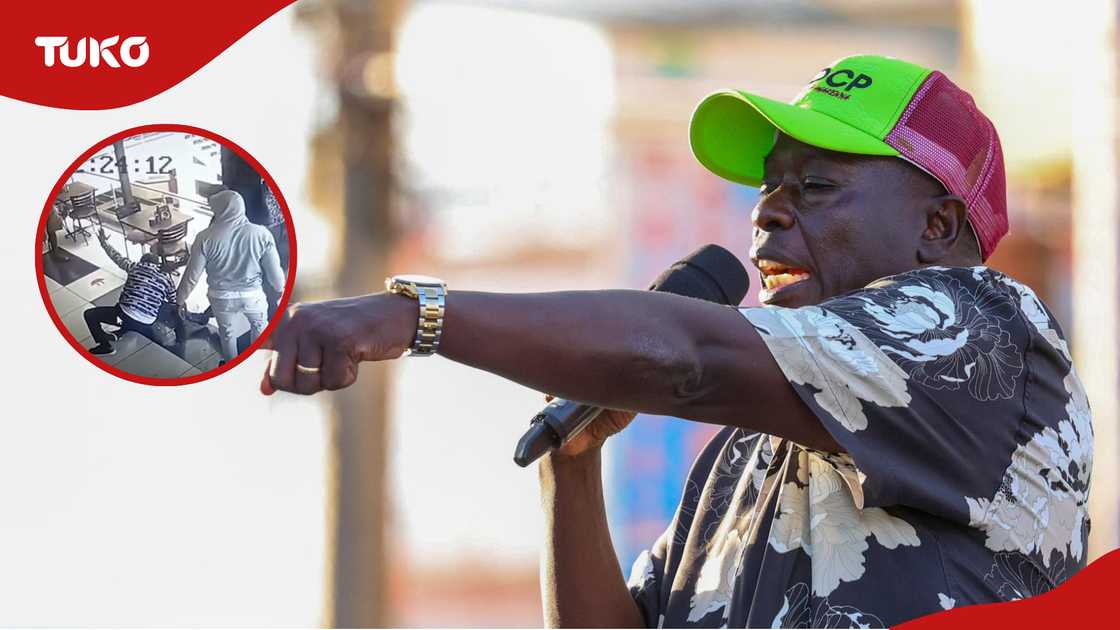






On Thursday, April 9, the local newspapers highlighted the fierce dispute as President William Ruto and his former deputy, Rigathi Gachagua, faced each other in public while sharing the stage for the first time since his removal from power.
Source: UGC
1. The Star
According to the daily, the Independent Electoral and Boundaries Commission (IEBC) has taken steps to calm public concerns following confusion over missing details in voter verification records, as the mass registration drive in Kenya gathers pace.
The Commission explained that the “Not Applicable (N/A)” entries appearing under polling stations and flow details are not errors, but a temporary result of the ongoing voter registration exercise.
IEBC it said the system will provide voters with special polling stations and flow once the exercise is over, with each station expected to have no more than 700 voters before the final roll is printed.

The clarification follows growing concern among Kenyans who, after checking their details online, discovered important information was missing.
Social media in recent days has been full of complaints, with some fearing data inconsistencies ahead of the 2027 General Election.
The IEBC sought to reassure the public, urging patience while the process continues and promising that all records will be updated once registration is complete.
The commission’s response comes just a week after it faced opposition over claims that voters who registered before 2012 will be required to re-register.
The IEBC has clarified that only those who have not been caught in the biometric system introduced after the 2010 Constitution need to re-register.
Officials stressed that the biometric register, used since 2013, remains the official register of voters.
2. Nation Today
According to the newspaper Swahili daily, police in Kisumu have launched an investigation into the shocking daylight attack on Godfrey Osotsi, who was attacked by a group of hooded men inside a restaurant, leaving him injured and sparking political outrage.
The incident happened shortly after noon, with witnesses describing how the attackers invaded the buildings and attacked the senator while the food staff and workers looked at him in surprise.

CCTV footage later showed Osotsi being repeatedly beaten and thrown onto furniture in a disgraceful attack that has raised concerns about public safety.
County Commissioner of PoisonousBenson Leparmorijo, confirmed that the investigation is ongoing, with the Directorate of Criminal Investigation (DCI) taking over the case.
Although the motive remains unclear, initial reports indicate that the attackers questioned Osotsi about his political stance before turning violent.
According to his communications director, the senator had previously interacted freely with the public before being confronted.
It is reported that its security officers refrained from using firearms to avoid endangering the lives of civilians in the crowded area.
Osotsi was initially treated at the Aga Khan Hospital in Kisumu before being airlifted to Nairobi for further treatment. Leaders across the political divide have since condemned the attack, calling it a dangerous escalation of political intolerance.
James Orengo he described the attack as unacceptable, while Mathew Owili wanted immediate action to be taken against those involved.
3. Daily Nation
The publication reports that a high-level crisis meeting chaired by Felix Koskei initiated a series of decisions that have now become the centerpiece of the ongoing oil scandal in Kenya.

Held on March 9 at the President’s Office, the National Security Council Committee (NSCC) instructed the Department of Petroleum to investigate alternative sources of fuel outside the government-to-government (G-to-G) system.
The move was prompted by fears that the growing crisis in the Middle East could disrupt supply chains and cause shortages.
The documents show Petroleum Secretary Mohammed Liban implemented the order, initiating emergency imports.
“Explore and implement strategies to diversify oil import sources beyond one region, reduce regional dependence and enhance national energy security,” the NSCC instructed Liban.
However, the process has since come under scrutiny, leading to the resignations of Liban, Kenya Pipeline boss Joe Sang, and Energy regulator chief Daniel Kiptoo.
Authorities allege that the trio manipulated oil reserve data to create false panic and justify expensive imports.
At the heart of the dispute is cargo imported into the MT Paloma, priced higher than G-to-G standards and later classified as substandard.
Energy Minister Opiyo Wandayi ordered it removed, citing a violation of established procedures.

Despite this, communications show that the government had approved emergency measures, including securing oil destined for other markets and relaxing quality standards under strict conditions.
This apparent contradiction has fueled debate about whether officials acted independently or within policy direction.
Since then, the NSCC has recommended long-term measures, including changing fuel sources and enhancing energy resilience.
4. The Standard
According to the newspaper, new revelations have deepened the mystery surrounding the death of 33-year-old Bernard Cheruiyot inside the Keringet Police Station, after a post-mortem examination contradicted the police’s explanation and pointed to a brutal attack.
Pathologist Titus Ngulu, who conducted the autopsy, concluded that Cheruiyot was beaten to death, suffering multiple injuries to the head, back, limbs and torso.
He ruled out self-harm, saying the injuries were consistent with a sustained blunt force attack.
The report further showed signs of torture, with evidence showing her hands and feet had been restrained. According to the results, severe head injuries and brain damage eventually led to his death.

This strongly contradicts the police’s earlier claim that Cheruiyot seriously injured himself by banging his head against the wall.
His family has rejected the police account, insisting he was in good condition when they last saw him in custody.
His wife, Faith Chebet, said he had complained of feeling cold but he was responding. He also claimed that the officials ignored his request to take him to the hospital.
Human rights activists have now raised concerns about possible foul play and the pattern of unexplained deaths in police custody.
Questions persist about how such a violent attack could happen inside a police cell without intervention.
Police say some of Cheruiyot’s colleagues have been arrested, while others have been released or turned into witnesses, but calls are growing for a thorough and independent investigation.
Read ENGLISH VERSION
Do you have an exciting story that you would like us to publish? Please contact us via news@tuko.co.ke or WhatsApp: 0732482690.
Source: TUKO.co.ke