





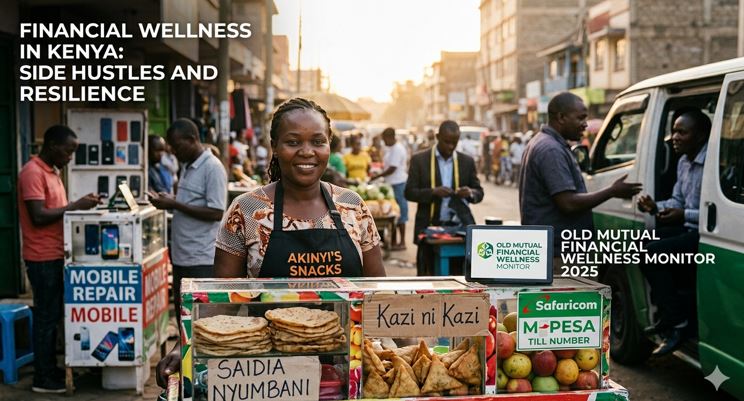
 Faced with a tightening economy, Kenyans are increasingly launching side hustles and scaling up existing businesses to bridge the gap.
According to the latest Old Mutual Financial Wellness Monitor, which tracks the financial health of the country’s workforce, 30% of working Kenyans reported earning more than they did a year ago. Furthermore, 47% now own or co-own a business, reflecting a widespread shift toward entrepreneurship.
Arthur Oginga, the CEO of Old Mutual, noted that this trend demonstrates a proactive approach to financial survival. Rather than waiting for a broader economic turnaround, citizens are taking direct action to stabilize their households.
“Kenyans are not waiting for the economy to improve. In the face of economic pressure, they are actively engineering their own recovery, adapting, innovating, and finding new ways to improve their financial position,” said Oginga.
The study credits this resilience to significant behavioral changes, highlighting that 91% of Kenyans now work toward specific savings goals. This disciplined approach to money management suggests a growing focus on long-term stability despite immediate challenges.
However, the report also acknowledges a difficult reality. This progress occurs against a backdrop of intense financial strain, driven by the soaring cost of living, mounting debt, and the ever-growing burden of domestic responsibilities on households.
The 2025 report highlights a precarious balancing act for many households, as 40% of Kenyans now rely on loans to cover basic daily expenses. Debt levels remain a significant concern, with 54% of the population carrying the same or more debt than they did a year ago, while 46% admitted to regularly exceeding their monthly budgets.
Vuyokazi Mabude, Head of Knowledge & Insights at Old Mutual, noted that while the nation shows remarkable spirit, the current progress requires more than just hard work to survive the long term.
“The 2025 report paints a picture of a nation in transition. Kenyans are resilient and entrepreneurial. But without stronger support in financial literacy, savings discipline, retirement planning, and protection, this progress risks remaining short-term,” she said.
The study found a surprising rebound in financial satisfaction among employed Kenyans aged 20-59 earning at least KES 12,000, compared to the lows of 2024. Interestingly, young adults in the 20-29 age bracket reported higher levels of contentment with their finances than they did in 2023.
Several key factors drive this sense of well-being, including a growing comfort with personal financial positions, more disciplined debt management, and a stronger ability to save. Many respondents also cited improved business performance over the last year as a major contributor to their optimism.
During a panel session, Dr. Tabitha Njuguna of Strathmore University Business School observed that Kenyans are moving away from passive money management toward more intentional financial planning.
“What we are seeing is a shift from passive financial behavior to active financial intent. Kenyans are working harder and setting goals, but they need the right tools, advice, and protection to translate this resilience into long-term financial security,” Dr. Njuguna said.
While optimism is rising, those reporting financial dissatisfaction point to a familiar set of hurdles: the high cost of living, stagnant wages that fail to cover basic expenses, and a lack of capital to scale their businesses. Despite these challenges, the survey found that overall financial satisfaction climbed from 5.2 out of 10 in 2024 to 5.9 in 2025. This newfound confidence stems from a belief in a stabilizing macro-environment, with 70% of respondents expecting their personal finances to improve within the next six months.
The Old Mutual Financial Wellness Monitor provides a deep dive into these shifting sentiments, tracking everything from daily spending habits to long-term risk management. The data reveals that income security has become the top priority for Kenyans in 2025, surpassing all other financial goals. To achieve this, many are focusing on cutting household expenses, seeking low-risk investment havens, paying down existing debt, and aggressively building emergency buffers.
The rise of the “poly-jobber” also highlights a significant shift in the labor market. The study found that 26% of Kenyans now juggle multiple roles or part-time gigs, up from 20% just a year ago. While this trend appears more common among affluent consumers, the financial impact is substantial; a quarter of these multi-job holders report that their side hustles now generate more income than their primary employment.
The study reveals that 46% of working Kenyans now belong to the “sandwich generation,” a group simultaneously supporting both their children and adult relatives. 79% of respondents said that taking care of their parents was the main reason for this financial burden, and 49% said that taking care of their siblings was the main reason. In 2025, the number of adult dependents went up by 4 percentage points, which put even more strain on household budgets.
This rising dependency correlates with a growing struggle to meet basic monthly obligations. The number of Kenyans falling behind on rent jumped from 17% to 25%, while those forced to dip into their savings to cover daily costs rose from 35% to 40%. Additionally, 28% of households reported falling behind on utility bills, a slight increase from the previous year.
To bridge these gaps, 40% of the population has turned to borrowing for everyday expenses. Mobile loans remain the most popular form of credit, followed closely by personal loans sourced from Chamas.
On a more positive note, over half of consumers (53%) now maintain enough savings to cover their expenses for three months or more – a 9 percentage point improvement since 2024. Despite this gain in stability for some, the data underscores a lingering vulnerability for the rest of the workforce, as 4 in 10 Kenyans risk running out of funds in less than three months should they lose their primary income.