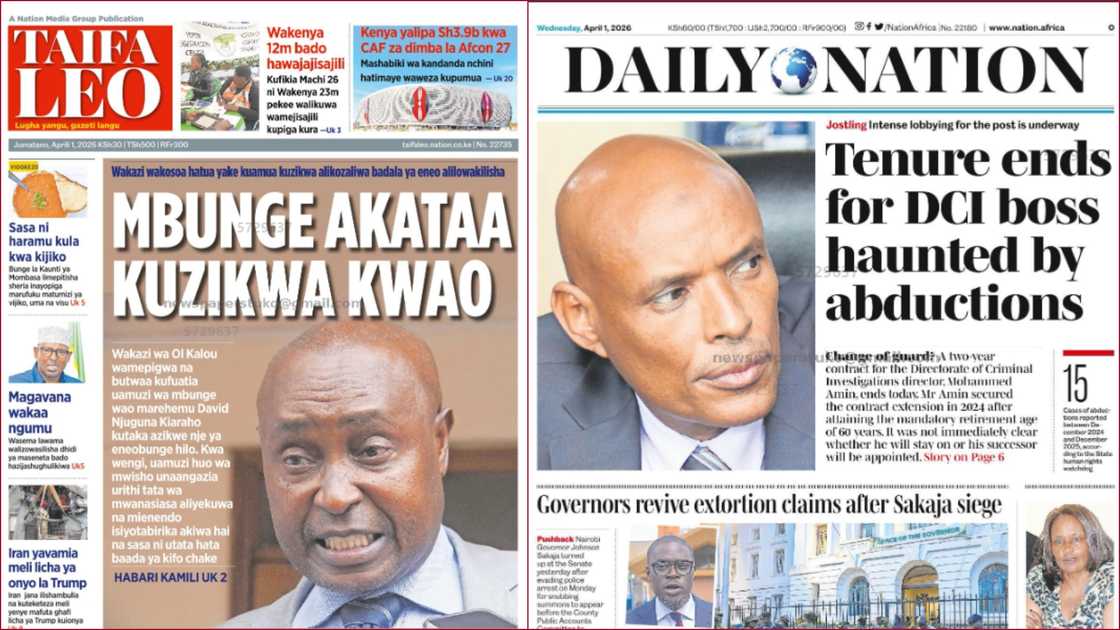




On Thursday, December 11, local newspapers reported extensively on a list issued by the US Department of Homeland Security (DHS), highlighting what it describes as the ‘worst of criminals’ foreigners, including 15 Kenyans.
Source: UGC
1. The Star
The daily reports that the oft-dismissed National Cohesion and Integration Commission (NCIC) could emerge quickly as Parliament moves to overhaul its mandate ahead of the 2027 General Election.
The proposed legislation, the National Coherence and Integration Amendment Bill, 2025, seeks to transform the commission from what critics have long called a “toothless dog” into a powerful enforcer of national unity.
The bill is sponsored by Mandera West Member of Parliament Yussuf Haji in his capacity as chairman of the National Equity and Equal Opportunities Committee and has been earmarked for priority consideration by the Council.
At the heart of the proposal is a provision that gives the NCIC direct authority to issue “cease and desist” orders against individuals or entities accused of engaging in divisive or hateful behavior.

Under Section 68A, such people would have seven days to comply, marking a sharp departure from the commission’s current approach to recording hate speech and seeking judicial intervention, a process widely criticized as slow and ineffective during political conflicts.
The bill also introduces severe penalties aimed at cleaning the house of the commission itself.
Commissioners and employees found to have conflicts of interest, such as doing business directly or indirectly with the commission, will face a fine of up to KSh3 million, prison sentences of up to seven years, or both.
Those with personal interests in the issues before the commission will be required to declare them and withdraw from the discussion.
Further reforms focus on transparency and accountability. All investigative hearings will be held in public unless there is a compelling reason to close them, with the NCIC required to submit detailed quarterly reports to the National Assembly.
The push for reform comes amid widespread criticism from lawmakers about NCIC’s inability to crack down on senior politicians accused of hate speech.
2. The Standard
The daily reports that the National Treasury has put a tight lid on its plan to sell a 15% stake in Safaricom to Vodacom, ignoring calls to instead dispose of the stake through the Nairobi Stock Exchange (NSE).

The proposal has sparked a public debate, with critics questioning why local investors were denied the opportunity to buy more shares in Kenya’s most profitable company.
At the center of the controversy is the sale price of KSh34 per share, which, although higher than Safaricom’s current NSE price of KSh28, has been called undervalued by some pointing to a peak of KSh45 recorded in 2021.
However, Finance Minister John Mbadi insists that a public offer would force the government to sell at a discount.
He said that releasing large amounts of stock into the market would increase supply, push prices down and affect profits.
Mbadi also linked the decision to wider privatization plans, warning that selling Safaricom shares domestically could undermine the Kenya Pipeline Company’s (KPC) initial public offering, scheduled for March next year.
According to the Fund, simultaneous major offers can stretch investors’ capital and undermine both transactions.
Under the agreement, the government expects to collect KSh244.5 billion, with Vodacom paying KSh204 billion for the shares and an initial KSh40.2 billion for the right to future Safaricom dividends.

Mbadi noted that Vodacom’s payment in US dollars will strengthen Kenya’s foreign exchange reserves and help stabilize the shilling.
He further advocated Vodacom as a strategic buyer with deep knowledge of Safaricom’s business.
Regarding concerns about public participation, Mbadi said Parliament will hold consultations, assuring Kenyans that their views will help shape the final decision.
3. Daily Nation
The publication reports that a coordinated political push is emerging within the United Opposition to install Wiper Party leader Kalonzo Musyoka as the preferred presidential candidate for the Mt Kenya region before the 2027 elections.
The center of this strategy is the former vice president Rigathi Gachaguawhose public endorsement has injected new energy and debate into opposition politics.
Through the Democratic Party for the People (DCP), Gachagua has described eight qualities that he believes make Musyoka the strongest candidate for the coalition, describing him as honest, experienced, and reliable.
He has repeatedly described Musyoka as “a gentleman who does not break agreements” and understands the cost of betrayal, saying that he is “a man who will not betray Kenya.”

The former DP says that these qualities set him apart in the increasingly competitive opposition field Eugene MalwaMartha Karua, Fred Matiang’i and Trans Nzoia governor George Natembeya.
Gachagua’s message shows a deliberate effort to give Musyoka a political club, portraying him as someone who deserves to “return home with dignity” after years of failed presidential bids.
He has also relied on numbers, stressing that Mount Kenya can produce between seven and eight million votes, while Ukambani, Musyoka’s stronghold, can collect up to four million.
Musyoka has welcomed the praise, describing Gachagua as an open-minded and clean-minded person, while re-emphasizing his long-term position in Ukambani politics.
Despite losing the position of running mate in 2022, Musyoka still gave Raila Odinga the local vote, a record that reinforces his reputation as a trusted political mobilizer.
However, the path is not smooth at all. Political experts warn that unity, campaign financing, voter participation, especially among Gen Z and managing collective nominations are still major obstacles for the opposition.
Gachagua’s recent attacks against the Jubilee Party and the former president Uhuru Kenyatta they have also raised questions about internal equality and the distribution of union territories.

Other opposition leaders have tried to calm concerns, insisting that the talks are part of building a healthy consensus.
They insist that the final presidential ticket will emerge through consensus and public participation, not political fatherhood.
“I warn our supporters that in order to get a better result, we must strive to find a better combination. All these talks are good. It means we are united. What matters is our final ticket, which will be an agreement,” Wamalwa said.
4. Nation Today
According to a Kiswahili newspaper, a grim picture of police violence has emerged after the Independent Medical and Legal Unit (IMLU) revealed that most of the 97 people killed by Kenyan police were shot from the back, pointing to a disturbing pattern of extrajudicial killings during protests and ordinary activities.
In its annual report released on International Human Rights Day, IMLU notes that three out of five extrajudicial killings involved the victims being shot while running, unarmed and without any threat.
Most of the deaths occurred during the protests, where police fired live shots into the crowd, causing panic as protesters tried to escape.

IMLU’s executive director, Grace Wangechi, said forensic evidence, drawn from medical and legal records, autopsies, survivor accounts and national surveillance, showed close-range shooting and gunshot wounds from behind, clear indicators of excessive force and recklessness.
He warned that such actions show a failure to follow international police standards and a breakdown in accountability.
In addition to the killings, IMLU recorded 18 deaths in custody, 72 cases of torture or ill-treatment, 49 protest-related injuries, more than 1,500 arbitrary arrests and five enforced disappearances.
The organization warned that these figures may reflect the true level of abuse due to threats and interference that prevent the collection of evidence.
The report focuses on the cases of individuals, including Elvis Musave, who was shot in the back during the Saba Saba protest last year in Kangemi while helping another injured protester.
Evans Kiche was also killed after being shot while running from the police during the riots in Kasarani.
IMLU monitoring officer Stephen Mukoya said more than 60% of violations of the law were recorded in Nairobi, describing the capital as a hub for the government’s crackdown on freedom of expression.
Read ENGLISH VERSION
Do you have an exciting story that you would like us to publish? Please contact us via news@tuko.co.ke or WhatsApp: 0732482690.
Source: TUKO.co.ke