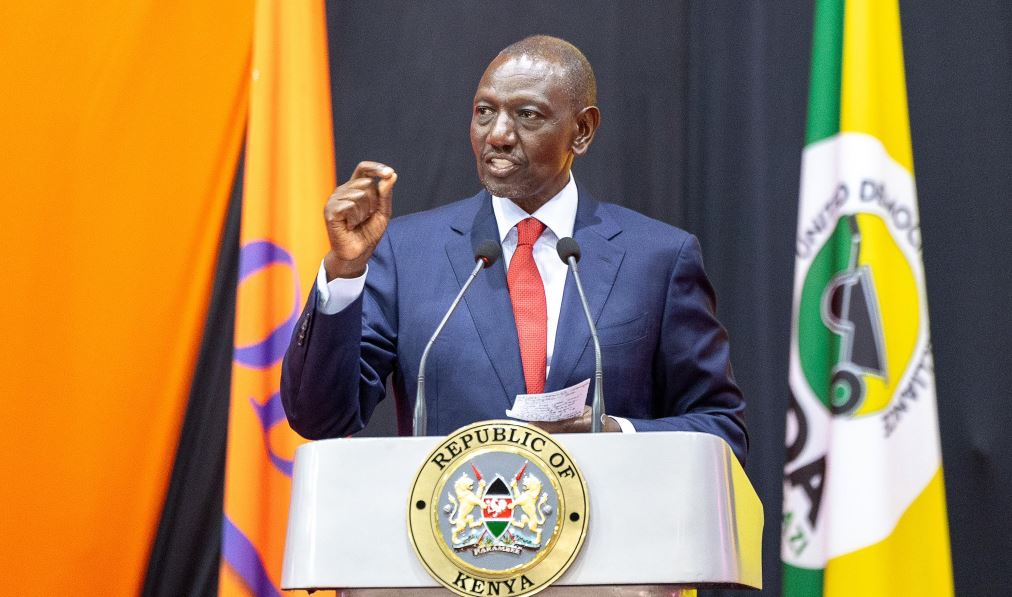







President William Ruto has defended his administration’s drive to expand financial inclusion, saying the Financial Inclusion Fund, better known as the Hustler Fund, has unlocked affordable credit for millions of Kenyans previously shut out by traditional lenders.
Speaking about the programme’s progress, President Ruto said the fund has disbursed over Ksh80 billion since its launch in November 2022, reaching individuals and small enterprises that banks and microfinance institutions had long excluded.
The President explained that the Hustler Fund was designed to empower micro and small enterprises (MSEs) that could not access loans because they were blacklisted by credit reference bureaus (CRBs).
“In 2022, we had about 7 million Kenyans, including 3 million micro enterprises, who were blacklisted on our credit reference bureaus. They could not access loans or operate their businesses,” Ruto said.
He added that the government took decisive action to help them rejoin the financial system.
“We took a firm position and negotiated with credit reference bureaus to redeem 7 million Kenyans who had been blacklisted and gave them a second chance. Today, we have 2 million Kenyans who borrow religiously from the Hustler Fund,” he said.
Ruto also revealed that more than 800,000 small businesses now benefit from the fund’s bridge finance product, which offers flexible credit to help them grow.
He emphasized that the fund has democratized access to credit by removing barriers such as collateral requirements.
“Today, an ordinary citizen without a payslip, title deed, or logbook can access up to Ksh150,000 on the Hustler Fund, with their credit record serving as the only collateral,” he stated.
To further strengthen small business growth, Ruto said the government is establishing County Aggregation and Industrial Parks in all 47 counties. These facilities will support agro-processing, link farmers and traders to value chains, and expand market access for MSMEs.
“We have also commissioned special economic zones in Busia-Nasewa, Naivasha, Eldoret, Kirinyaga, and Dongo Kundu in Mombasa to attract foreign investment, boost industrialisation, and expand regional trade,” he added.
The President noted that the Affordable Housing Programme has complemented these economic reforms by creating thousands of jobs for youth and empowering the Jua Kali sector through government contracts to supply doors, windows, and fittings.
To accelerate digital commerce, Ruto said the government is laying a 100,000-kilometre digital superhighway to improve internet access and drive e-commerce across the country.
“Already, 30,000 kilometres of the digital superhighway are complete, supported by nationwide digital literacy training. Public Wi-Fi will soon reach local markets, and digital hubs will be established in all 1,450 wards,” he said.
The President said these initiatives align with his administration’s vision to build a digitally connected, financially inclusive, and self-reliant Kenya.