




The Kenya Wildlife Service (KWS), under the Ministry of Tourism and Wildlife, has unveiled a nationwide public participation process to gather input on proposed adjustments to park entry and conservation fees.
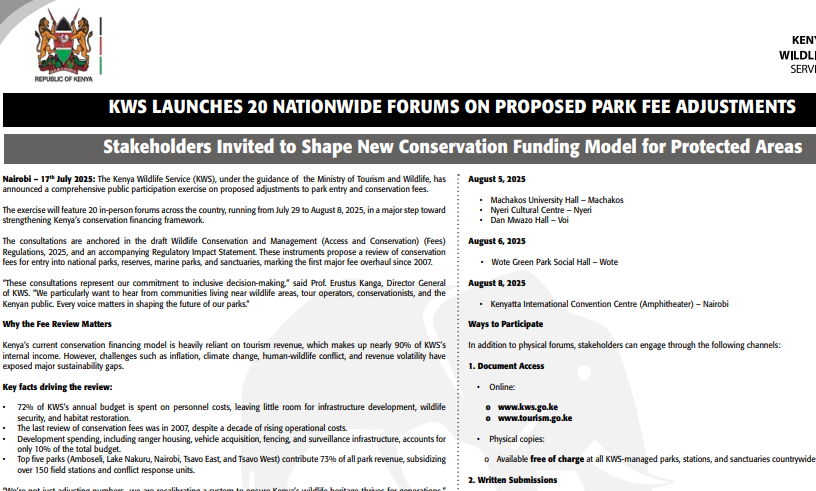
The consultations will run from July 29 to August 8, 2025, featuring 20 in-person forums across key counties expected to spark national dialogue around the first major review of conservation fees since 2007.
The forums will be conducted in Homa Bay, Hola, and Marsabit on July 29, 2025, and on July 30, 2025, in Kisumu, Meru, and Lamu. Kitale, Chogoria, and Watamu on July 31, 2025; on August 1, 2025, in Eldoret, Nanyuki, and Mombasa; and on August 4, in Nakuru, Embu, and Ukunda. On August 5, 2025, events will be held in Machakos, Nyeri, and Voi. On August 6, an event will be held in Wote, and on August 8, 2025, another event will be held in Nairobi.
According to a notice by KWS dated July 17, 2025, the forums aim to modernise Kenya’s conservation financing model through the draft Wildlife Conservation and Management (Access and Conservation) (Fees) Regulations, 2025, and its accompanying Regulatory Impact Statement.
In the notice, KWS Director General Erustus Kanga stated that the consultations represent the government’s commitment to inclusive decision-making.
“We particularly want to hear from communities living near wildlife areas, tour operators, conservationists, and the Kenyan public. Every voice matters in shaping the future of our parks.”
Reasons for the review
Kenya’s protected areas depend heavily on tourism, which currently contributes nearly 90 per cent of KWS’s internal revenue. However, the model is under increasing pressure due to rising costs, inflation, climate change, and human-wildlife conflict.
Key facts driving the review:
• 72 per cent of KWS’s annual budget is spent on personnel costs, leaving little room for infrastructure development, wildlife security, and habitat restoration.
• The last review of conservation fees was in 2007, despite a decade of rising operational costs.
• Development spending, including ranger housing, vehicle acquisition, fencing, and surveillance infrastructure, accounts for only 10 per cent of the total budget.
• Top five parks (Amboseli, Lake Nakuru, Nairobi, Tsavo East, and Tsavo West) contribute 73 percent of all park revenue, subsidising over 150 field stations and conflict response units.
“We’re not just adjusting numbers; we are recalibrating a system to ensure Kenya’s wildlife heritage thrives for generations,” Kanga added.
Physical forums: stakeholders can engage through www.kws.go.ke, www.tourism.go.ke, and physical copies are available at all KWS-managed parks, stations, and sanctuaries free of charge.
Similarly, written submissions can be sent via email to [email protected] or by postal address. The deadline for all submissions is August 5, 2025.
The proposed changes will ensure the financial sustainability of Kenya’s conservation efforts, support improved infrastructure in parks and protected areas, enhance visitor experiences and safety, strengthen human-wildlife conflict response mechanisms, and expand community benefit-sharing programs, especially in regions adjacent to protected areas.
Following the conclusion of the public participation process, all feedback will be analysed and consolidated into a final report, the draft Regulations will be revised accordingly, and a final version will be submitted to Parliament for review and approval