






In Kenya, every new school fire reignites an old, painful question: how many more children must die before we take safety seriously?
When 21 boys perished in a dormitory fire at Hillside Endarasha Academy in Nyeri in 2024, the country mourned—again. Parents screamed outside the charred remains, desperate for answers, clinging to the hope that their sons had escaped. They hadn’t. The fire, fuelled by wooden dormitory structures and overcrowded conditions, spread too fast.
There were no alarms. No working extinguishers. No chance.
It wasn’t the first time. It won’t be the last—unless something changes.
School fires in Kenya are tragically familiar. From Kyanguli in 2001 to Moi Girls Nairobi in 2017 and Kajiado in 2025, we’ve seen this story unfold again and again: flames, panic, locked doors, grilled windows, and young lives lost. The pattern is chilling. Yet after every tragedy, the nation goes silent, only for the cycle to repeat.
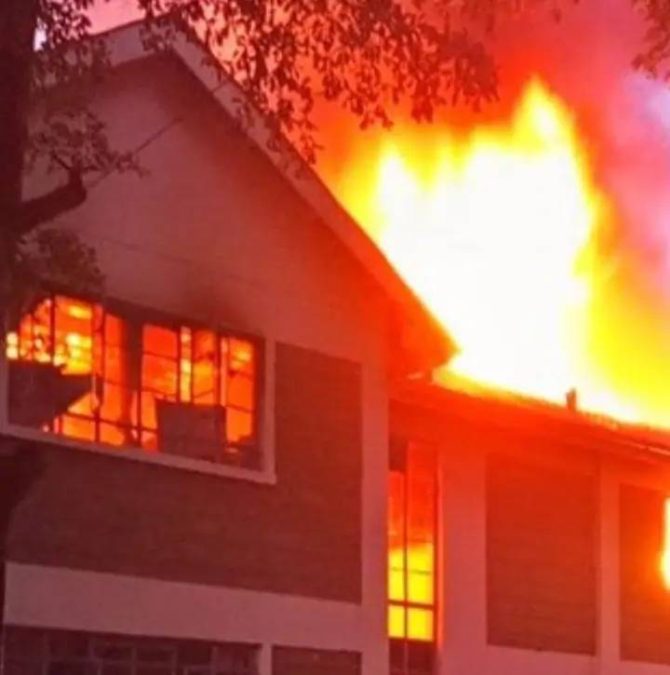
In Kenya, every new school fire reignites an old, painful question: how many more children must die before we take safety seriously?
When 21 boys perished in a dormitory fire at Hillside Endarasha Academy in Nyeri in 2024, the country mourned—again. Parents screamed outside the charred remains, desperate for answers, clinging to the hope that their sons had escaped. They hadn’t. The fire, fuelled by wooden dormitory structures and overcrowded conditions, spread too fast.
There were no alarms. No working extinguishers. No chance.
It wasn’t the first time. It won’t be the last—unless something changes.
School fires in Kenya are tragically familiar. From Kyanguli in 2001 to Moi Girls Nairobi in 2017 and Kajiado in 2025, we’ve seen this story unfold again and again: flames, panic, locked doors, grilled windows, and young lives lost. The pattern is chilling. Yet after every tragedy, the nation goes silent, only for the cycle to repeat.

Ogamba, in a statement issued on Wednesday, September 11, 2024, said the inspection, which will be done in phases, will be conducted by the Ministry of Education jointly with relevant agencies.
“It has, therefore, become necessary for the Ministry of Education, jointly with relevant agencies, to conduct an urgent countrywide inspection of all public and private basic learning institutions to assess their levels of compliance with the guidelines of the Safety Standards Manual for Schools in Kenya.
“The first phase of this inspection, which started this week, will cover all boarding primary and junior schools in the country, while the second phase of the inspection exercise will cover secondary schools. The inspection will involve officials from the Ministries of Education, Interior and National Administration, and Health and the Department of Public Works. It will also involve officers from the county governments and the Kenya Red Cross,” Ogamba’s statement reads in part.
What makes this even more tragic is that many of these fires are preventable. In some cases, they are started deliberately by frustrated students. In others, faulty wiring or unattended flames are to blame. But the damage is always worsened by the same issues—locked doors, poor infrastructure, and no alarm systems. The real fire is not in the matchstick—it’s in the negligence.
After the Endarasha fire, leaders promised action. Investigations were launched. Condolences were offered. But will anything change? History suggests otherwise.
End the cycle now
Kenya cannot afford to treat school safety as an afterthought. We must make a decisive shift—from reactive mourning to proactive protection.
First, the government must enforce existing safety rules—not just in Nairobi but in every village and ward across the country. Schools should be inspected regularly, and those that don’t comply must face consequences, including closure. This shouldn’t be negotiable. It should be law, with no exceptions.
Second, schools need resources. Yes, budgets are tight, especially for rural institutions. But can we truly say we can’t afford extinguishers, alarms, and safe exits when the cost of inaction is children’s lives? County governments, education boards, and even parents’ associations should prioritise safety infrastructure the same way they prioritize textbooks and uniforms.
Third, we need to change how we listen to students. Some fires are started by children pushed to the edge—by exam pressure, by harsh rules, or by a system that gives them no voice. We can’t keep punishing symptoms without addressing causes. Schools should invest in counselling, peer mentorship, and forums where students can express their frustrations constructively.
Fourth, parents and communities must stay engaged. Too often, we assume schools are safe simply because they’re registered. But parents have the right—and responsibility—to ask tough questions: Are there fire drills? Are exits accessible? Are the dorms too crowded? Communities should organise and push for transparency and accountability.
And finally, Kenya must start viewing school fires not just as isolated tragedies, but as a national crisis. Every dormitory that burns is a mark of shame on our conscience. Every child lost is a future stolen—not just from their family, but from the country.
One grieving parent at Endarasha asked through tears, “Why didn’t the school protect my son?” There was no answer—because the school couldn’t. But Kenya can.
It’s time to fireproof our schools—not just with equipment, but with urgency, with leadership, and with the will to do better. We have mourned enough. We have buried enough. Now we must act.
Because no child should go to school and never come home.