




Digital strategist Dennis Itumbi has come out strongly to criticise Anglican Archbishop Jackson Ole Sapit over his recent remarks questioning President William Ruto’s decision to build a church within the State House.
According to Itumbi, the Anglican Archbishop should not be asking who is meant to serve as the spiritual head of the new sanctuary, as by tradition, history, and institutional design, that role already belongs to him.
In a detailed post shared on Saturday, July 5, Itumbi explained that Archbishop Ole Sapit, as the head of the Anglican Church of Kenya, is by default the National Chaplain—a spiritual role that dates back to colonial times.
He argued that when the British constructed the State House, they deliberately allocated a prime piece of land next to Gate A known as Archbishopbourne.
This property was not a random decision; it was set aside with the specific intention that the Archbishop of the Anglican Church would serve as a spiritual adviser to the governor and later, the president.
The Archbishopbourne residence, which now serves as Archbishop Sapit’s official Nairobi home, even contains a 100-seater chapel—designed to host prayer sessions and offer counsel to the Head of State.
According to Itumbi, the spiritual infrastructure has always existed within reach of the State House, symbolising a long-standing expectation that the Anglican Archbishop would assume the role of spiritual shepherd to the presidency.
“It’s surprising that the Anglican Archbishop would publicly pose the question of who should serve as the State House Bishop. For the record: when the British colonialists constructed State House, they also deliberately carved out a premium parcel of land right next to Gate A. That property is called Archbishopbourne,” Itumbi stated.
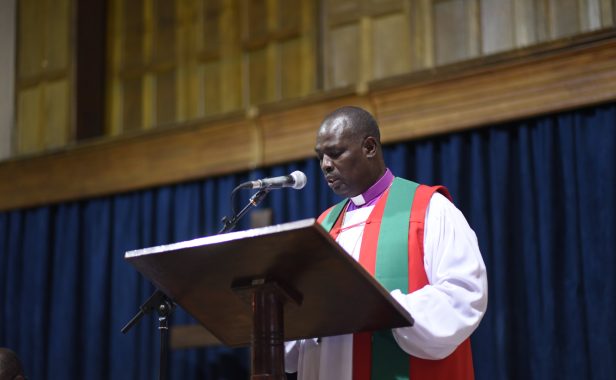
Anglican Church
However, Itumbi lamented that since no Anglican has ever been elected president, successive archbishops have shied away from embracing the national chaplaincy fully.
He noted that this reluctance stems from a fear of shedding denominational boundaries, despite the institutional and geographical indicators pointing toward that responsibility.
He also cited former President Uhuru Kenyatta’s attempt to establish a formal State House Chaplain by appointing a Catholic priest, a process that was eventually derailed by civil service bureaucracy despite being sanctioned by the President himself.
“But history took its own course. Since no Anglican has ever been elected president, successive archbishops have often hesitated to shed denominational identity and fully embrace the role of national chaplain. The opportunity has always been present, but the church I grew up in has not always stepped into it,” he added.
“President Uhuru Kenyatta once attempted to formalise a similar role, appointing a Catholic priest as a State House Chaplain. But the civil service bureaucracy ran the appointee in circles until the process stalled and faded despite a direct presidential instruction,” he added.
Itumbi’s message to Sappit
Itumbi now says that Archbishop Ole Sapit must rise to the occasion, not by asking rhetorical questions about who should serve as the State House Bishop, but by recognising and accepting the historic and divine mandate already placed on his shoulders.
In his view, tradition, proximity, and spiritual duty make Sapit the natural National Chaplain—a role he must now embrace without hesitation.
Ole Sappit’s reaction
This comes after Jackson Ole Sapit, the Archbishop of the Anglican Church of Kenya, sharply criticised President William Ruto’s plan to build a Ksh1.2 billion church at State House, calling it a violation of Kenya’s constitutional secularism.

Ole Sapit argued that the project blurs the line between religion and state, questioning its necessity given the presence of nearby churches.
He also raised concerns about its governance, including whether Ruto would assume a spiritual leadership role. He warned that the church risks signalling Christianity as a state religion, which would conflict with Article 8 of the Constitution, and urged a reevaluation of the project to uphold Kenya’s commitment to religious neutrality.