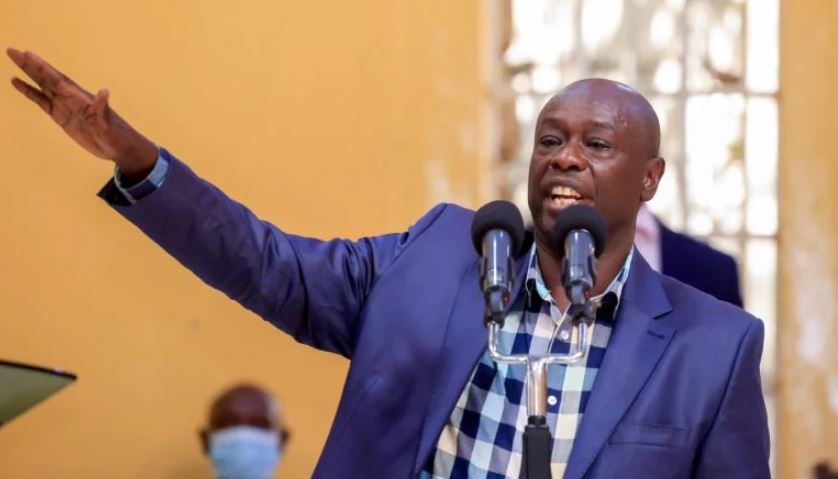






Kesses MP Julius Rutto has condemned the politicisation of Kenya’s police service, warning that it is costing lives and threatening the country’s future.
Speaking during an interview on a local TV station on Thursday, July 3, 2025, Rutto said the country is paying the ultimate price for allowing politics to infiltrate independent institutions like the police.
“It is time as Kenyans uphold the sanctity of life. We are paying the ultimate price for politicising independent institutions like the police service and using them over time to push political agendas through actions like extrajudicial killings,” Rutto said.
His remarks come at a time when Kenya is grappling with a disturbing wave of police brutality, abductions and extrajudicial killings.
Abductions and extrajudicial killings
Since June 2024, rights groups estimate that more than 70 people have been abducted, and at least 26 are still missing. Most of those targeted are young protesters, human rights defenders or citizens caught in the chaos.
The unrest has been largely fueled by growing anger over government policies such as the Finance Bill 2024, which sparked nationwide demonstrations. The response from security forces has been swift and violent.
On June 8, 2025, 31-year-old blogger Albert Omondi Ojwang was arrested for allegedly defaming a senior public official. He died in police custody less than 24 hours later. While police claimed he had harmed himself, a post-mortem revealed severe head injuries and neck trauma, pointing to torture.
His death caused national outrage and renewed calls for accountability.

/X
During another protest on June 17, a peaceful demonstrator who was also a street vendor was shot in the head at close range by police. He survived the initial shooting but was hospitalised and later declared brain dead, then died shortly after. The incident, captured in photos and videos, sparked even more anger and drew thousands into the streets.
The situation escalated further on June 25, when demonstrations spread to 23 counties across Kenya. At least 19 people were killed in clashes between protesters and police. In Nairobi, chaos erupted. Protesters clashed with police, torched two police stations, and looted businesses.
Interior Minister Kipchumba Murkomen accused the demonstrators of trying to overthrow the government.
“Security agencies are acting to stop what we believe is a coordinated attempt to overthrow the government,” he said, comments that only inflamed tensions.
Kinyagia’s disappearance
Amid the chaos, the mysterious disappearance of blogger and tech activist Ndiang’ui Kinyagia on June 21 has become a powerful symbol of the state of the nation. Kinyagia was taken from his home in Kinoo, Kiambu County, in the middle of the night.
Eyewitnesses say several men in an unmarked vehicle stormed into his house, seized his electronics, and left with him. The men are believed to be from the Directorate of Criminal Investigations (DCI).
His family immediately went to court, seeking a habeas corpus order to force the police to produce him. On June 30, the High Court ordered Inspector General Douglas Kanja and DCI Director Mohamed Amin to present Kinyagia or explain his whereabouts.

When they failed to do so, the court issued a fresh summons on July 1, 2025, demanding that the blogger be produced dead or alive. DCI Director Amin was also ordered to appear in person before the court on July 3, 2025.
During the July 1 court session, a man suddenly stormed the courtroom and shouted,
“Stop lying. You abducted Ndiang’ui Kinyagia. Enough is enough… Extrajudicial killings and disappearances must end now.” Court officers quickly removed him.
The DCI denied involvement, claiming Kinyagia had left his home voluntarily with two women and a man. They also accused him of inciting unrest by sharing protest timetables online, including calls for demonstrators to occupy the State House. However, the family’s lawyer, Wahome Thuku, dismissed the claims.
“The first thing the police should do is look for the missing person… You don’t suspend one part of your responsibility to pursue another,” Thuku said.
He also pointed out that the DCI had not provided any documentation to support their version of events.
Kinyagia’s case is not unique. Many others, particularly those linked to protests, have vanished without a trace. Families continue to search hospitals and morgues, hoping for answers. Those who reappear often report torture, threats, and fear of speaking publicly. Others are found dead. Most remain missing.