





Former Attorney General Justin Muturi has come out strongly to condemn the recent abductions, including that of DCP Youth League leader Ms Wanjiku Thiga, terming the acts as state-sanctioned terrorism.
In a statement released on his X account on July 2, 2025, Muturi stated that the abduction of Kenyans is not law enforcement but is instead akin to state terrorism.
Muturi criticised the growing trend of abductions in Kenya, arguing that such actions have no place in a constitutional democracy. He accused the Directorate of Criminal Investigations (DCI) and the police of abandoning due process and replacing it with fear, force, and lawlessness.
Muturi warned that disguising abductions as arrests violates constitutional protections, particularly Article 49, which outlines the rights of arrested persons — including the right to be informed promptly of the reason for arrest, the right to communicate with legal counsel, and the right to be presented before a court within 24 hours.

He argued that these actions mirror the tactics of dictatorships and failed states, ultimately eroding public trust and legitimacy. According to Muturi, a government that fights crime by committing crimes loses its moral authority. The increasing confusion between legitimate police work and criminal behaviour, he said, is a national tragedy and a dangerous path that must be halted.
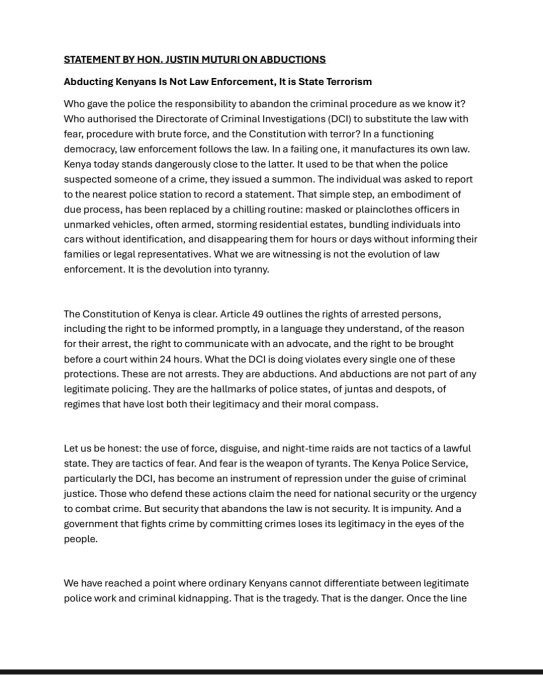
“Who gave the police the responsibility to abandon the criminal procedure as we know it? Who authorised the Directorate of Criminal Investigations (DCI) to substitute the law with fear, procedure with brute force, and the Constitution with terror? In a functioning democracy, law enforcement follows the law. In a failing one, it manufactures its own law. Kenya today stands dangerously close to the latter, “ Muturi stated.
Government to take responsibility
He went further to state that President William Ruto and the Interior Ministry must take full responsibility for the growing wave of abductions. According to him, it is the government’s duty to rein in rogue officers, disband covert arrest squads, and publicly reaffirm the supremacy of the Constitution. Failure to take such action, he warned, risks steering the country down a dark and irreversible path.
“President William Ruto and his Interior Ministry must take full responsibility. They must rein in rogue officers, disband covert arrest squads, and publicly reaffirm the supremacy of the Constitution. If they fail to do so, they risk taking Kenya down a dark, irreversible path,” he added.
The issue, he noted, is not partisan. It is not about opposition versus government but rather about the rights of every Kenyan to live in a country governed by the rule of law, where arrests follow lawful procedures and fear does not permeate households.
The police service, he emphasised, must be reminded that their authority is derived not from firearms or titles, but from public trust and constitutional legitimacy.
The boundary between law enforcement and criminality has become increasingly blurred, leaving citizens defenceless. Many can no longer tell whether a person knocking on their door at 2 a.m. is a rogue officer or a criminal posing as one.
This erosion of legal certainty is dismantling public trust in the police and creating a breeding ground for lawlessness on all sides.
Even more alarming is how society has begun to normalise this climate of fear. Abductions are now being treated as part of everyday life. The media often refers to them as “arrests” without question, and government officials dismiss them as necessary actions. But such silence, he cautioned, marks the beginning of state terror.
When the public fails to call out these abductions for what they are, it contributes to the steady erosion of civil liberties. Accepting the sight of unmarked vehicles abducting young protestors from the streets is, in effect, a betrayal of the Constitution.
He further argued that these abductions are not random — they are political.
The targets are often critics of the regime, vocal citizens, protestors, and anyone demanding accountability. ‘It is no coincidence,’ he added, ‘that the same state that has failed to create jobs, lower the cost of living, or deliver justice is now using brute force to silence dissent.’ This is not a matter of crime prevention; it is about preserving power.
Kenya’s criminal justice system, he concluded, is not failing because the Constitution is flawed. It is failing because those responsible for upholding it have become its greatest violators. The problem is not the absence of laws but the absence of courage and accountability.
The Directorate of Criminal Investigations (DCI) is not above the law — it is a product of it. When it acts outside the bounds of the law, it ceases to serve justice and instead becomes an agent of oppression.