




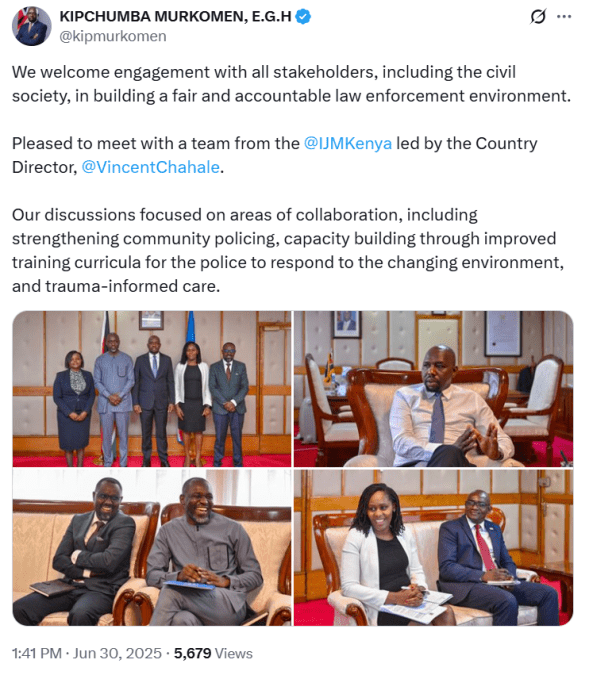
Interior Cabinet Secretary Kipchumba Murkomen on Monday, June 30, 2025, held a crucial meeting with representatives from the International Justice Mission (IJM) Kenya amid heightened scrutiny over police conduct during recent nationwide protests.
The closed-door session, held, was attended by IJM Country Director Vincent Chahale and focused on collaborative solutions to strengthen community policing and law enforcement accountability.
According to Murkomen’s post on X, the discussions centred on enhancing police training curricula, equipping officers to respond to emerging threats, and integrating trauma-informed care into policing.
These engagements come at a time when the country is grappling with the aftermath of violent demonstrations, which resulted in over 10 deaths and over 400 injuries, including 300 police officers.
Speaking at a press conference in Nairobi on June 26, 2025, Murkomen announced that more than 400 people had been injured in the protests. Murkomen revealed that about three hundred police officers were injured during protests commemorating victims of the June 2024 anti-government demonstrations.
“More than 10 Kenyans were killed; investigations are ongoing into the circumstances under which this happened. Over 400 people were injured; close to 300 were police officers, and some left with injuries they will carry for the rest of their lives,” he stated.
Murkomen’s meeting with IJM, a global organisation that supported more than 70,000 victims of violence in 2024 alone, signals the government’s intent to rebuild public trust amid rising concern over excessive use of force.
The Law Society of Kenya has condemned recent incidents as “unnecessary aggression,” while human rights bodies have raised alarm over growing authoritarian tendencies in protest response.
Controversy over Murkomen’s remarks
The backdrop of the meeting includes Murkomen’s own controversial remarks, where he referred to the protests as a “coup attempt disguised as dissent,” sparking fierce online backlash. Critics have accused him of greenlighting a “shoot-to-kill” policy—claims he has denied, insisting he was reiterating provisions already enshrined in the law.
In the wake of violence that marred the June 25 protests, Murkomen sparked a storm with his directive to police: shoot anyone attempting to storm a station.
He made the remarks on Thursday, June 26, 2025, during a tour of several damaged police facilities. The reaction was swift: jeers, boos, and immediate questions.
His remarks have, however, sparked outrage from Kenyans, who are terming his directive as unlawful.
Photos shared online showed Murkomen and IJM officials in active consultation, poring over documents, suggesting a structured review of policing policy. While some online users praised the engagement as a step toward accountability, others remained sceptical, questioning whether such forums lead to real change on the ground.
Path forward for police accountability
This meeting comes just days after the deadliest week of protests since Kenya’s 2010 Constitution was enacted—one that created a National Police Service bound by human rights obligations. With calls for justice mounting and civil society demanding transparency, the outcome of these discussions could influence future security sector reforms.
The dialogue remains a symbolic gesture on how swiftly the recommendations are implemented in policy and practice.