






Wiper Party leader Kalonzo Musyoka says he has moved to court to challenge the Communication Authority’s controversial directive banning live coverage of the ongoing Gen Z memorial protests.
In a strongly worded statement shared on Wednesday, June 25, Kalonzo accused the government of attempting to suppress the truth by using force to interfere with media broadcasts.
He described the shutdown of live coverage as an outrageous abuse of power and a direct violation of constitutional freedoms.
He said that armed officers, in the company of Communications Authority officials, stormed a transmission station and cut off its free-to-air signal as part of a wider effort to silence coverage of the protests.
“A regime that sends police to shut down media is a regime running from truth. Armed officers, alongside Communications Authority officials, stormed a transmission station and forcefully switched off its free-to-air signal,” he said.
Kalonzo cited Articles 34 and 35 of the Constitution, which protect media freedom and access to information, saying these rights are not optional. He also referenced a 2023 High Court ruling, Kenya Editors Guild & Others v. Communications Authority & Others, which barred the authority from interfering with live broadcasts.
He said disregarding this decision amounts to contempt of court and contempt for democracy.
He insisted that live reporting of public demonstrations is part of the media’s civic responsibility and not a threat to national order. According to him, the true danger lies in a government that fears media scrutiny more than it fears public unrest.
“It is not just contempt of court but also contempt for democracy to disregard the verdict that reaffirmed that no government agency may place prior restrictions on the press. Live reporting is not a threat. It is a civic duty. Silencing it is a desperate act of state insecurity,” the opposition leader stated.
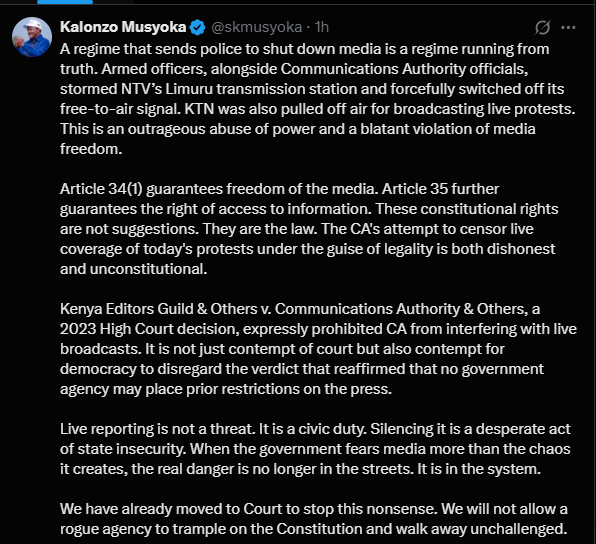
Kalonzo also said that legal action had already been taken to stop what he termed as a rogue agency from trampling on the Constitution, though this claim has yet to be independently confirmed.
CA’s ban on coverage
The Communications Authority earlier issued a directive to all licensed TV and radio broadcasters, instructing them to stop any live airing of the protests with immediate effect. The authority argued that such coverage violated constitutional provisions and the Kenya Information and Communications Act.
It warned that broadcasters who defy the order risk regulatory penalties, including fines, suspension, or cancellation of licences.
“This is therefore to direct all television and radio stations to stop any live coverage of the demonstrations forthwith,” the statement signed by Director General David Mugonyi read.
Adding;
“Failure to abide by this directive will result in regulatory action as stipulated in the Kenya Information and Communications Act, 1998. The Authority looks forward to your continued cooperation,” CAK noted.
The protests, which have grown in size and intensity across Nairobi, Mombasa, Kisumu, and other towns, began as a youth-led push for transparency and good governance. The movement, largely driven by Gen Z, has since evolved into a broader call to address long-standing issues of accountability and social justice.