






The Law Society of Kenya (LSK), together with a broad coalition of civil society groups, has issued a stern warning to the Communications Authority of Kenya (CA), demanding an immediate reversal of its directive banning live coverage of the ongoing Gen Z-led protests. Failure to comply, they warned, would trigger urgent legal action.
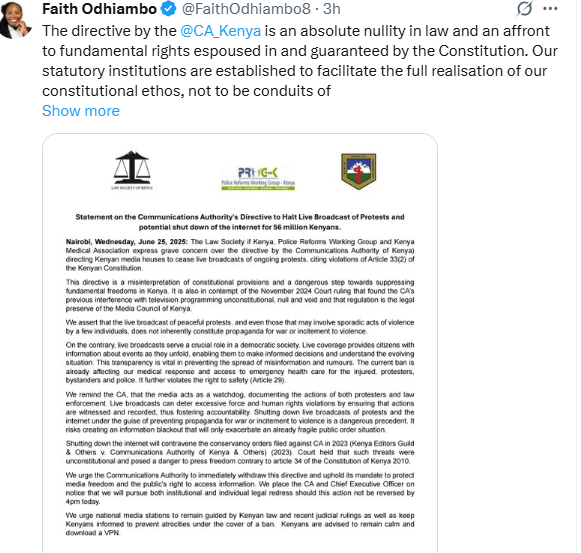
In a joint statement released Wednesday, June 25, 2025, the coalition—which includes the Kenya Medical Association (KMA) and the Police Reforms Working Group (PRWG)—condemned the CA’s order as a violation of constitutional rights and an overreach of its mandate.
“This directive is a dangerous step towards suppressing fundamental freedoms in Kenya,” the groups declared.
CA Director General David Mugonyi had earlier cited Articles 33(2) and 34(1) of the Constitution and Section 461 of the Kenya Information and Communications Act as the legal basis for the media blackout. He warned that noncompliance would attract regulatory consequences.
However, the civil society alliance argues the directive constitutes a gross misinterpretation of the law. They pointed to a November 2024 High Court ruling that declared a similar attempt by the CA to control live programming unconstitutional, reaffirming that only the Media Council of Kenya holds the authority to regulate broadcast content.
“We place the CA and chief executive officer on notice that we will pursue both institutional and individual legal redress should this action not be reversed by 4 pm today,” read the statement.
The coalition emphasized that live broadcast of protests—even when there are isolated cases of unrest—is not equivalent to incitement or propaganda, but a democratic necessity.
“Live coverage provides the public with real-time information, counters misinformation, and promotes government accountability. It is an essential function in any democratic society,” the statement said.
The groups also raised alarm over the humanitarian implications of the blackout, arguing that the suppression of live reporting and potential internet disruptions are already hindering access to emergency medical care for injured protesters, police, and bystanders. Such outcomes, they said, violate the right to security under Article 29 of the Constitution.
Fight for press freedom
They warned that cutting off media and internet access would plunge the country into an information blackout, potentially worsening the unrest and eroding public trust.
“Live broadcasts can deter excessive force and human rights violations by ensuring that actions are witnessed and recorded, thus fostering accountability,” the statement added.
The coalition further noted that any move to restrict internet access would be in contempt of a 2023 court order prohibiting such actions, reaffirming protections for press freedom under Article 34.
The organisations called on all media houses to stand firm, adhere to constitutional principles, and continue providing accurate, timely coverage.
They also encouraged citizens to stay calm and consider downloading Virtual Private Networks (VPNs) to maintain access to information in the event of an internet shutdown.
The statement was signed by the LSK, KMA, PRWG, and more than a dozen other civic organisations committed to safeguarding media freedom, human rights, and lawful policing.