





Kenyan comedian and activist Eric Omondi has called for the renaming of streets to honour the young people who lost their lives during the anti-government protests in June 2024.
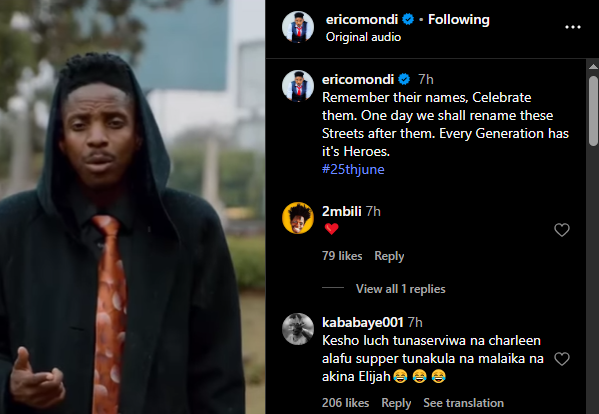
In a message on his Instagram page shared on Tuesday, June 24, 202, Omondi urged Kenyans to remember and celebrate the fallen, saying that every generation has its heroes and that someday, the country should rename streets in their honour.
“Remember their names, Celebrate them. One day, we shall rename these Streets after them. Every Generation has its Heroes,” Eric Omondi stated.
Omondi’s suggestion comes just a day before the country marks the first anniversary of the deadly demonstrations.
As the country prepares for the Gen Z memorial protests scheduled for Wednesday, June 25, 2025, emotions are already running high. The day will mark exactly one year since the youth-led protests turned tragic after police opened fire on unarmed demonstrators who were protesting the now-withdrawn Finance Bill.
Their names
At the centre of the planned memorials are names that have come to symbolise a generation’s demand for justice. Among them is Rex Kanyeki Masai, a 29-year-old who was shot dead in Nairobi on June 20, 2024.
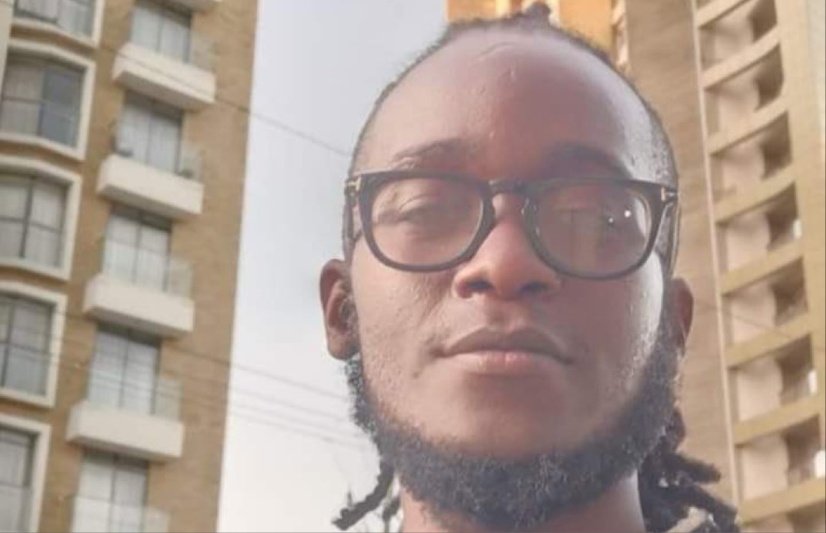
Abdi Kadir was injured by a gunshot during the first wave of protests in June. He died in the hospital on July 16 and was buried the next day. He was only 24 years old.
Evans Kiratu lost his life after being hit by a tear gas canister. Police were using tear gas to disperse crowds, but in his case, it led to a tragic end.
Eric Shieni, a university student who was about to graduate in September, died during protests outside Parliament. He lived in South B with his brother. His death deeply hurt his family and friends.
David Chege was a computer science graduate from JKUAT, working as a freelance IT expert. Like Eric, he died near Parliament. His future was full of potential before it was suddenly taken away.
Beasley Kamau went missing after attending the protests. Days later, on June 26, his body was found at the City Mortuary. His disappearance and death caused public anger and raised serious questions about how the protests were handled.
Nineteen-year-old Ibrahim Kamau had just finished high school and wanted to study electrical work. He was shot twice in the neck during the storming of Parliament and died. He was among many young people demanding that MPs reject the Finance Bill.
The youngest victim was twelve-year-old Kennedy Onyango, who was killed during protests in Rongai. His death left many Kenyans heartbroken and highlighted the heavy cost of the demonstrations.
Wednesday
Vigils and peaceful demonstrations are expected in major cities including Nairobi, Kisumu, Mombasa, Eldoret, and Nakuru. In Nairobi, mourners are set to gather at Memorial Park, where families of the victims have already held prayer meetings and candlelight vigils in the days leading up to the anniversary.
In Kisumu, young people plan to march through the city centre with banners and placards bearing the faces and names of the fallen. Many will be dressed in black, while mothers are expected to smear dark paste on their faces in symbolic mourning and solidarity.
The planned memorial has also caught the attention of the international community. On June 24, twelve foreign embassies, including those of the United States, the United Kingdom, and Germany, issued a joint statement urging the Kenyan government to respect citizens’ right to peaceful assembly.
They called on authorities to avoid intimidation and violence, allowing Kenyans to honour their dead with dignity.