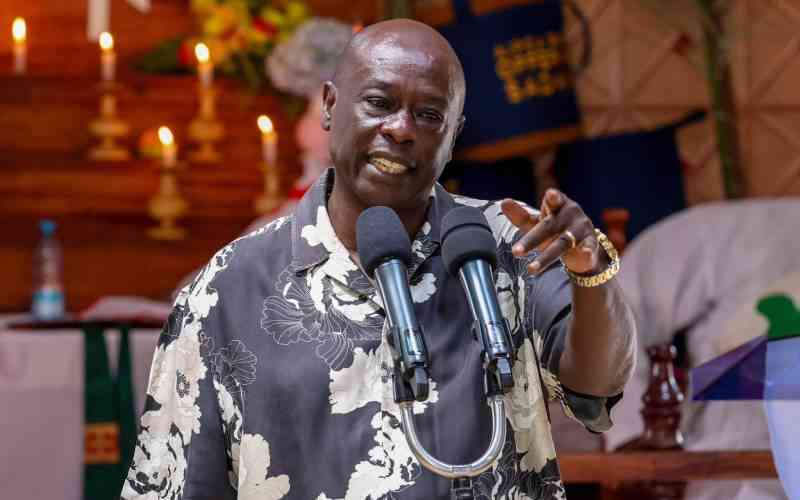




Amnesty International Executive Director Houghton Irungu has sharply criticised the National Police Service over what he termed as poor policing practices that have led to an erosion of public trust and growing fears of lawlessness.
Speaking in an interview on a local TV station on Monday, June 16, 2025, in response to recent cases of police brutality, including the killing of 31-year-old Albert Ojwang, Irungu said the police must urgently reform or risk further radicalising the public.
Irungu painted a grim picture of a security system that has lost credibility among the public due to repeated instances of extrajudicial killings and enforced disappearances.
“In a manner in which we do not see more body bags, we do not see more cover-ups, we do not see the public begin to feel that this system of policing no longer has their trust,” Irungu said.
“Ultimately, what happens is a sense of lawlessness begins to develop where people say, ‘Well, if the police can break the law, why shouldn’t we be allowed to break the law?”
He warned that the consequence of continued impunity within the police service could lead to dangerous societal breakdowns.
“There’s one step from authoritarianism to anarchy. And every time we see a death like the one of Albert, essentially what happens is you radicalise several people because they say, ‘Well, the police are not abiding by the rule of law. Why should we?’ And then we lose everything,” he said.
Albert Ojwang’s death, which Amnesty believes was the result of police misconduct, has sparked widespread outrage and scrutiny of the conduct of the officers involved.
His death, Amnesty argues, could have been prevented if standard policing procedures had been followed.
“I’m sure that the officers that picked him on that Saturday afternoon a week ago were not in any way clear that this would be an issue that would embroil not just themselves, their commanders, but the entire National Police Service,” Irungu remarked.
Call for police reforms
He added that the situation had now reached a point where the public was intensely scrutinising statements from top police officials, including the Inspector General, the Directorate of Criminal Investigations (DCI), and the Independent Policing Oversight Authority (IPOA).
“To have a situation where the public is beginning to scrutinise every single word of the Inspector General, the spokesperson, the director of criminal investigations, and the independent oversight authority is quite remarkable because Kenyans are now clear that they have to get involved in policing,” Irungu observed.
“And it is unnecessary. If the police followed the law, we would not have reached this point.”
Irungu cited a troubling statistic from IPOA, noting that out of 60 cases related to police killings of protesters last year, only two have resulted in prosecutions.
“Two out of sixty is just too low a number, and that’s why there is scepticism around this particular case,” he said.
Irungu said adding to the public’s mistrust were the glaring inconsistencies in the police’s timeline and communication. Following Ojwang’s disappearance, his family, along with members of the Law Society of Kenya (LSK) and other legal representatives, spent the day at Central Police Station demanding information. However, no officer came forward with the truth.
“The entire day, nobody was willing to tell them the truth. And the truth was that Albert was in the mortuary. He had been there for several hours, but nobody had the courage just to come and explain what was happening. That’s when I think Kenyans began to feel that there is a cover-up,” Irungu stated.
As investigations continue, Amnesty International demands full accountability from the officers involved. Irungu insisted that every officer who came into contact with Ojwang should be treated as a persons of interest.
“We must demand, for example, that all the officers that came into contact with Albert — they need to be arrested, they need to be investigated, their gadgets need to be handed over, and the time logs, the phone logs and the vehicle logs need to be handed over to the independent political authority,” he said.