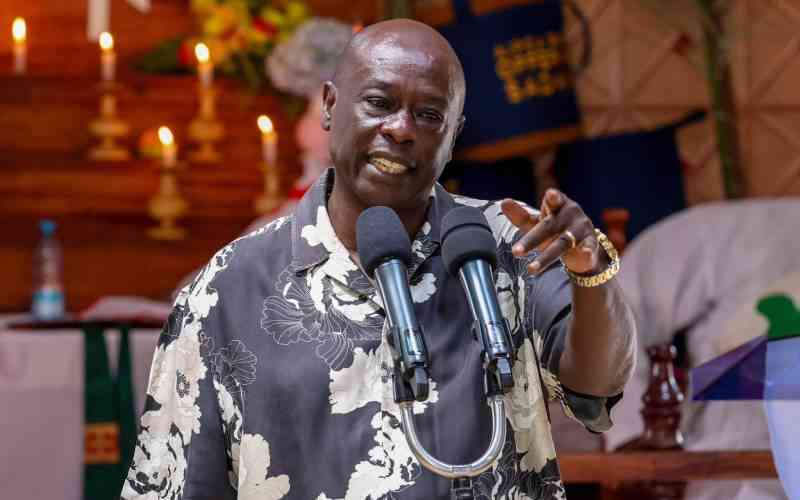




Treasury Cabinet Secretary John Mbadi has shared his long-term vision for the country and what he hopes his legacy will be once he leaves office.
Speaking during a televised interview on Thursday, June 12, 2025, ahead of presenting the 2025/2026 national budget to the National Assembly, Mbadi emphasised his desire to be remembered as a reformist.
He said his goal is to fight corruption, stabilise the economy, and ensure public finances are managed transparently and inclusively.
Mbadi explained that he wants to open up the operations of the Treasury to the public, shifting away from the closed-door approach that has characterised the institution for years. He stressed that national resources belong to the people and should be handled with accountability.
“I want Kenyans to remember me for implementing reforms that eliminate waste and corruption, stabilise the economy, and manage public debt. I want to be remembered as a person who opened the Treasury, and the public got more involved in matters National Treasury, not a closed system as before. Because it is for the people, the finances are for the people,” he said.
Mwanachi-friendly budget
The national budget for the 2025/2026 Financial Year is projected at Ksh4.239 trillion. It is aligned with President William Ruto’s Bottom-Up Economic Transformation Agenda (BETA) and Vision 2030, focusing on economic reforms, job creation, and inclusive growth.
In response to growing criticism of the Finance Bill 2025, Mbadi has been defending the proposed legislation, insisting it is people-friendly and that widespread claims circulating online are false.
Speaking during a public forum in Kibra on Monday, June 9, 2025, Mbadi dismissed reports that the Bill introduces VAT on essential food items like bread, milk, and maize flour. He accused opposition leaders of spreading misinformation to mislead Kenyans.
“In the Finance Bill that is before the National Assembly, there is no provision for putting VAT on bread, milk, and unga. The basic commodities are not even mentioned,” he said.

He went further to clarify that the widely discussed neonatal tax, a plan to tax newborns, is completely fictitious. According to the CS, the claim is part of a misinformation campaign that is not based on the actual contents of the Bill.
“I heard that we are going to tax newborn babies, that is a propaganda Bill. Kenyans need to read the Bill for themselves and not entertain propaganda manufactured elsewhere,” he explained.
Last year, the government had proposed to impose a 16% VAT on essential items like bread, cooking oil, sugar, potatoes, onions, table eggs, and even services such as bank transactions and mobile money transfers. The bill also included an eco-levy on items like diapers, sanitary towels, batteries, and mobile phones.
Those proposals sparked outrage across the country, with civil society groups, industry players, and the public taking to the streets in protest. The pressure forced President William Ruto’s administration to back down and withdraw the controversial plans.
Eventually, the administration decided to maintain the zero-rated status of basic food items and scrap the planned taxes on financial services and eco-sensitive products.
In contrast, the Finance Bill 2025 focuses more on green energy and supporting agriculture. The bill proposes VAT exemptions for electric bicycles and buses, helping Kenya transition to clean energy. It also gives tax relief on animal feed production inputs to support farmers.
However, the bill plans to remove VAT exemptions on goods used in affordable housing projects. This move suggests the government is trying to find new ways to fund its housing agenda without touching everyday consumer goods.
So far, key food items such as bread and eggs remain unaffected by the 2025 proposals, likely in response to last year’s backlash.