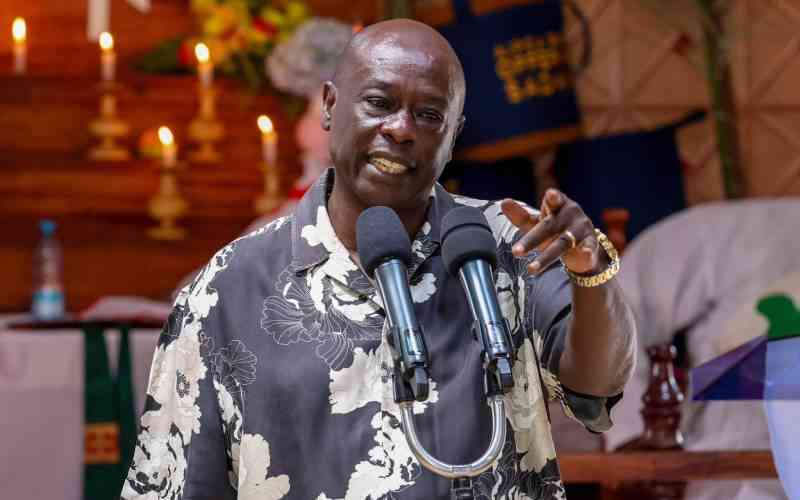

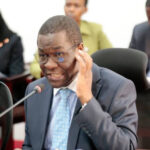


Former Roots Party presidential running mate Justina Wamae has called on Africans to take an active role in electing leaders who can influence and shape policies that support the development of their countries.
Her remarks come in the wake of a new travel ban announced by United States President Donald Trump, which restricts nationals from several African and other countries from entering the US.
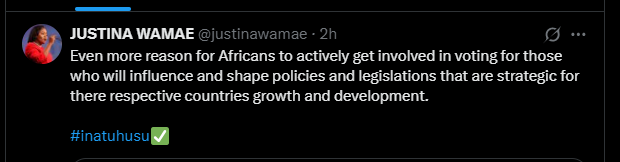
In a statement posted on her X account on Thursday, June 5, 2025, Wamae emphasised the need for proactive citizen participation in leadership choices, especially in light of such international decisions.
“Even more reason for Africans to actively get involved in voting for those who will influence and shape policies and legislations that are strategic for their respective countries’ growth and development,” she stated.
About the ban
President Trump signed a proclamation barring entry into the United States for nationals of 12 countries, citing national security risks. He also imposed partial travel restrictions on citizens from seven other nations.
According to the White House, the restrictions are aimed at protecting Americans from what they described as dangerous foreign actors. The administration said the policy will be reviewed periodically and may be adjusted if countries improve their internal security standards or expanded if new threats arise.
Trump defended the move, pointing to a recent incident in Boulder, Colorado, where 12 people were injured after an Egyptian national attacked a gathering in support of Israeli hostages.
Although Egypt is not on the list of banned countries, the attack was used to illustrate what Trump called the risks of insufficient vetting of foreign nationals.
The full ban applies to citizens from Afghanistan, Myanmar, Chad, the Republic of the Congo, Equatorial Guinea, Eritrea, Haiti, Iran, Libya, Somalia, Sudan, and Yemen.
In addition to the full travel ban, the US has imposed partial restrictions on seven more countries: Burundi, Cuba, Laos, Sierra Leone, Togo, Turkmenistan, and Venezuela. Citizens from these countries may still be allowed to travel under specific circumstances, but their access to visas and entry will be significantly limited.
The policy provides a few exemptions. Athletes attending international sporting events such as the 2026 World Cup or the 2028 Olympics may still be allowed into the US.
Others exempted include lawful permanent residents of the United States, certain visa holders like persecuted minorities from Iran, Afghan nationals with special visas, and dual nationals whose second nationality is from a country not affected by the ban.
The Secretary of State also has the authority to make exceptions on a case-by-case basis if it serves US national interests.
Trump’s first travel ban, issued in 2017, triggered protests and lawsuits across the US. That order initially targeted several Muslim-majority countries and was widely referred to as a Muslim ban. The policy was later revised and upheld by the US Supreme Court in 2018. President Joe Biden repealed the ban in 2021, calling it a stain on the national conscience.