

Audio By Vocalize

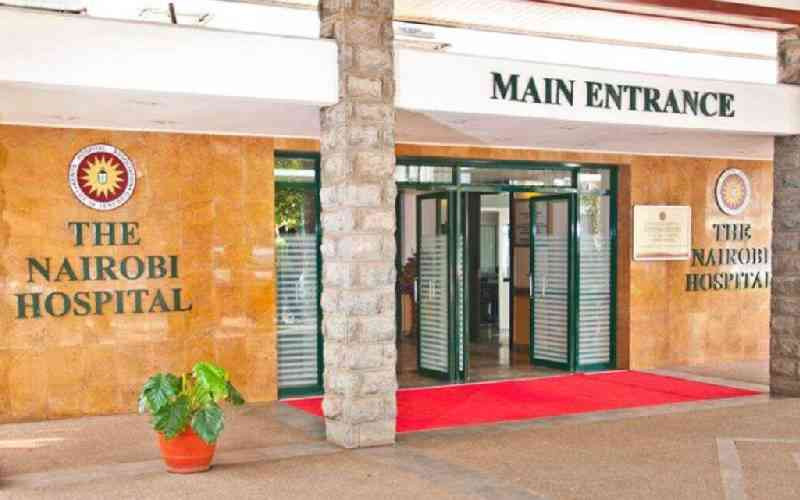
The High Court in Nairobi has ordered the Nairobi hospital to release a 78-year-old cancer patient, who allegedly had been detained over a Sh4 million hospital bill.
This comes as the same court extended orders barring the government from interfering with the affairs of Nairobi Hospital management.
The hospital was directed to discharge the patient codenamed LMM, and release her treatment records. Her lawyer Ng’ang’a Mbugua told the court that she had already paid Sh1 million, and had a back up of more than Sh5 million from a private insurance and Social Health Insurance Fund (SHIF).
The lawyer claimed that the demand for Sh4 million was a result of the hospital’s negligence, as she fell in the hospital’s ward toilet.
“Several requests to have the itemised medical bill, including the itemised bills for the respective physicians who attended to the Petitioner and their respective invoices, first respondent has declined and or deliberately refused to furnish the same to the petitioner or applicant, contravening her right to access her records or information relating to her,” argued Ng’ang’a.
The hospital, on the other hand, argued that she was free to leave when she committed to pay the amount.
However, Ng’ang’a argued that the issue was that the demanded bill was contested as it accrued after she fell.
In the management case, Justice Gregory Mutai issued the twin orders despite the opposition by the Attorney General Dorcas Oduor and the Asset Recovery Agency (ARA) that they were wrongly listed in the case.
The AG, on one hand, told the court that she is not involved in the criminal justice system, while the ARA said that there was evidence to show that it had harassed the hospital’s management.
The Directorate of Criminal Investigations (DCI) also stated that it had not intimidated or harassed them, as the Public Service Commission (PSC) argued that it had been wrongly enjoined in the case. PSC argued that it had not issued any directive or interfered with the hospital’s internal affairs.
The Nairobi Hospital board members sued the Head of Public Service Felix Koskei, the Director of Public Prosecution Renson Ingonga, the Director of Criminal Investigations Mohammed Amin, the Kenya Revenue Authority, the Registrar of Companies and the Attorney General Dorcas Oduor, citing interference with the private hospital.
A day after Ingonga withdrew charges against three members, Barcley Mogere Onyambu, Dr Magdalene Koki Muthoka, and John Nyiro Mwero, the hospital’s management, led by Gilbert Nyamweya, Akiyi Gaya, Prof John Mwero, and Kenya Hospital Association accused the government officials of illegally implementing a coup.
According to them, although the hospital has had internal wrangles, the courts have been the point of call.
However, in their case filed before the High Court, the board members claimed that on March 6, this year, it took a different twist when President William Ruto referred to them as crooks, conmen and charlatans.
Stay informed. Subscribe to our newsletter
They further said that Dr Ruto then vowed that he would ensure that they are kicked out and dragged to court with charges.
“ In the same public address, the President further declared, in unequivocal and categorical terms, that he had “instructed with clarity that persons involved in the affairs of the seventh petitioner would be “removed’ and “charged,” court papers read in part.
The group led by Nyamweya further said that the President’s threats were buttressed by the State House Spokesperson, Mr Hussein Mohamed, who alleged that Koskei had been allegedly tasked to ensure stability and strengthen governance within the hospital.
According to them, this was an illegal state takeover of affairs of a private company.
“The petitioners aver that the cumulative effect of the foregoing public declarations and executive communications was to trigger and legitimize direct State involvement in the internal affairs of a private association, thereby blurring the constitutionally mandated separation between public authority and private corporate governance,” they continued.
The court heard that KRA allegedly started tax assessment, three directors were arrested and charged, and all their vehicles were placed under a caveat by the Asset Recovery Agency (ARA).
However, according to the Nairobi Hospital directors, the moves were premature as the DPP allegedly admitted in court that the investigations were incomplete.
Nevertheless, they further claimed that KRA allegedly started its own probe using the same claims that had been withdrawn in court.
They argued that all this was being done to exert pressure on them to relinquish their positions.
The directors admitted that they were in court over the hospital’s management. They however questioned why the Executive was undertaking a parallel process from that of the court.
“The Petitioners state that these actions were not undertaken through any lawful statutory mandate, nor were they grounded in any enabling legal framework. Instead, they constituted ad h o and extra-legal manoeuvres aimed at exerting State control over a private entity, justified solely on the basis of alleged internal wrangles within the Hospital Community,” the court heard.
They were of the view that the issues bedevilling the premier facility can be resolved without the involvement of the State and its machineries.
At the same time, the directors said that the moves by the police and KRA were in violation of court orders in Kibera and the High Court in Nairobi, which barred the DCI from either summoning or questioning them.
According to them, the DPP and the DCI turned a blind eye to the clear orders and had three of them arrested on a Friday and charged on a Monday.
This, they argued, was an affront to legal process and fairness.
“ This sequence of events demonstrates that the criminal process has been inverted and abused, wherein charges are initiated first, and investigations conducted thereafter in search of possible offences, contrary to established principles of criminal justice,” they said.
The directors want the court to find that the arrests and detention were illegal and against court orders. They are also seeking compensation and an order barring the government from meddling with the hospital’s affairs.