


 The National Assembly approved the Supplementary Appropriations Bill on April 2, 2026, which expands the national budget by 9.1%. This legislative move raises total government expenditure from Ksh.4.301 trillion to Ksh.4.695 trillion, reflecting an additional injection of Ksh.393.1 billion into the economy. Of this new funding, the national government receives Ksh.363.8 billion, while Consolidated Fund Services accounts for Ksh.29.27 billion.
The security sector claims the largest share of this supplementary allocation, receiving Ksh.60 billion to bolster national safety operations. Within this total, the State Department for Internal Security and National Administration gains Ksh 11.9 billion. This specific funding supports a variety of critical initiatives, including Ksh.3.9 billion for security operations, Ksh.2 billion for the National Integrated Security Command and Control System (NISCCS), and Ksh.4 billion for police modernization and security infrastructure.
Furthermore, the government has set aside Ksh.2 billion to compensate victims of demonstrations and police brutality.
The education sector also benefits significantly from the revised budget. The Teachers Service Commission (TSC) receives Ksh. Ksh.24.2 billion to resolve salary shortfalls and cover health insurance contributions for teachers, alongside an additional Ksh. 3 billion specifically designated to clear pending bills for teachers’ medical cover.
The government has directed significant additional funding toward higher education and electoral stability as part of the recently signed Supplementary Appropriations Bill. The Higher Education Loans Board (HELB) receives an extra Ksh.4.1 billion to expand student support, while Ksh.3.88 billion is earmarked to clear outstanding university salary arrears dating back to the 2017–2021 Collective Bargaining Agreement (CBA) and to bolster the “Wings to Fly” program within the Technical and Vocational Education and Training (TVET) sector.
The budget also provides substantial infrastructure and operational support for higher learning institutions. The State Department for Higher Education receives Ksh. 6 billion to support Moi University and Kabarnet University, along with Ksh. 1.5 billion for the University Funding Board. Furthermore, the government has allocated Ksh.2.6 billion toward capital expenditure for the Kenya-China TVET Project Phase III, a development partner-funded initiative designed to enhance vocational training capacity across the country.
Meanwhile, the Independent Electoral and Boundaries Commission (IEBC) secures Ksh.2.9 billion specifically to settle its long-standing legal bills. Officials state that these targeted investments aim to ensure institutional stability, modernize security command systems, and restore public confidence in critical electoral and educational institutions.
To enhance tax collection and reduce the need for public borrowing, the government has allocated Ksh.17.6 billion to the Kenya Revenue Authority (KRA). This funding supports the taxman’s goal of reaching a revenue target of Sh2.97 trillion by the end of the 2026 financial year.
The healthcare sector received a significant boost of Ksh. 4.7 billion through the State Department for Medical Services and Ksh. 775 million for Public Health and Professional Standards. A major portion of this – Ksh.4 billion – is dedicated to clearing the pending bills of the defunct National Health Insurance Fund (NHIF).
To improve regional healthcare, the government directed Ksh.675 million toward upgrading Level 4 hospitals and provided Ksh.5.4 billion for medical internships, bringing the total internship budget to Ksh.9.8 billion. Additionally, Moi Teaching and Referral Hospital receives Ksh.2.5 billion, while Ksh.2.6 billion supports the national vaccine program.
In the infrastructure and housing sectors, the government has prioritized regional connectivity and urban development. The State Department for Roads receives Ksh. 4.5 billion for the Horn of Africa Gateway development projects. Meanwhile, the Affordable Housing Programme – a core pillar of the ruling Kenya Kwanza national development agenda – secures a massive Ksh.25 billion to accelerate construction and improve living standards across the country.
The agriculture sector receives over Ksh.17 billion in this supplementary budget, which includes Ksh.10 billion for the fertilizer subsidy program, Ksh.1 billion for tea reforms, and Ksh.1 billion for MSME agricultural credit through the Agricultural Finance Corporation (AFC). The allocation further provides Ksh.2 billion to support sugar reforms, including the clearance of salary arrears, and Ksh.1.5 billion for initiatives focused on food security and crop diversification.
The government also commits Ksh.350 million to the Blue Economy and Forestry, Ksh.2 billion to the Forestry Department, and Ksh.500 million to the Watershed Improvement Project (KEWASIP) to expand reforestation and safeguard vital watersheds. To finance these expenditures, officials plan to adopt non-tax revenue mobilization strategies, such as privatization and securitization.
“With improved economic conditions and stronger revenue efforts, the government is better positioned to support its citizens while maintaining overall fiscal stability,” the report notes.
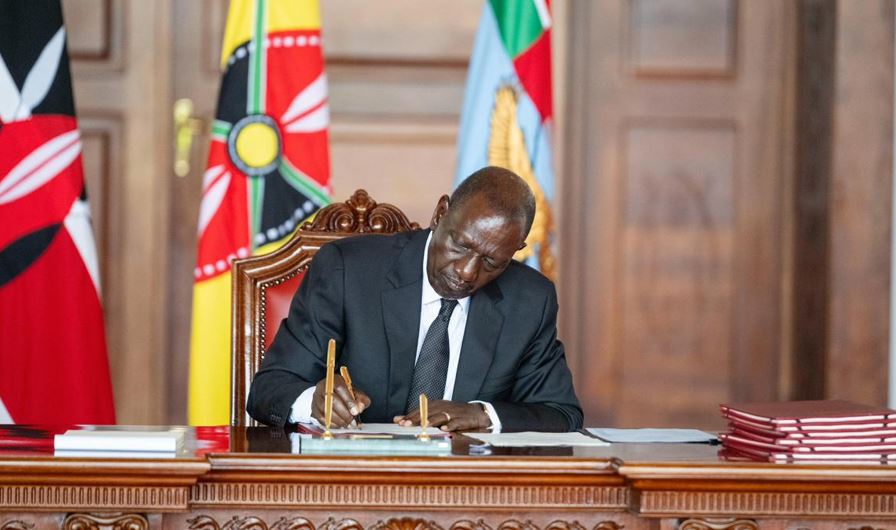
President William Ruto has officially assented to the bill.