



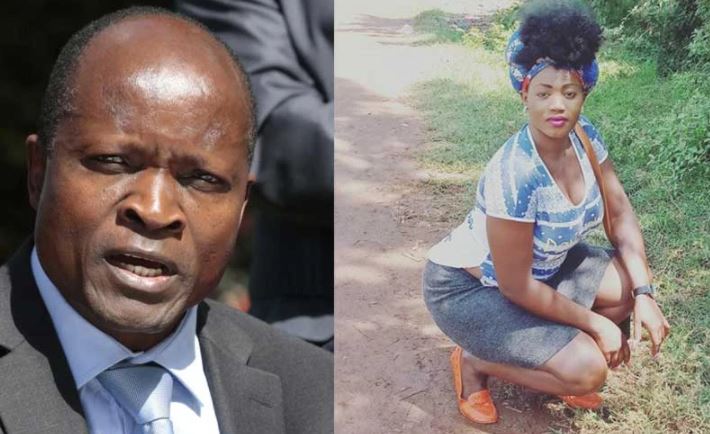
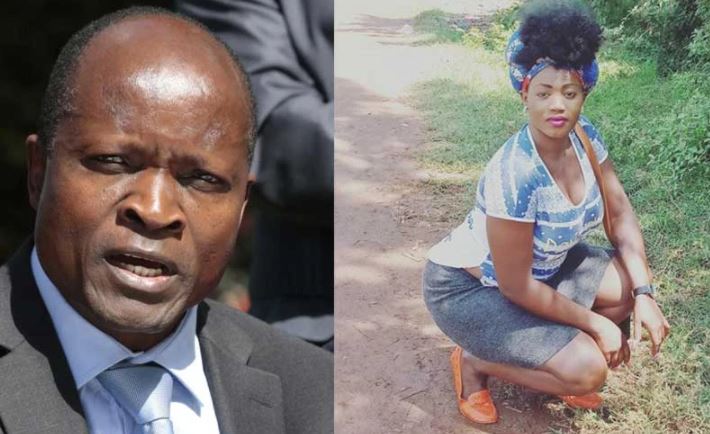
 After years of testimony, mountains of evidence, and a trial that has gripped Kenya since 2021, former Migori Governor Okoth Obado and two co-accused will finally learn their fate on May 29, 2026.
Lady Justice Cecilia Githua set the date on Wednesday, March 18, scheduling the verdict for an open session at the Milimani High Court in Nairobi – bringing one of Kenya’s most high-profile murder cases one step closer to a conclusion.
Obado faces the charge alongside his former personal aide Michael Oyamo and Casper Ojwang, in connection with the September 2018 killing of Sharon Otieno, a Rongo University student whose murder sent shockwaves across the country.
Why the Court Needs More Time
When the parties gathered to fix the judgment date, Justice Githua was direct about why May and not sooner.
“Given the many volumes of proceedings and the many exhibits in this matter as well as the latest submissions filed by the parties, the court will need sufficient time to prepare the judgment, and for that reason, I reserve the judgment for May 29, 2026,” she stated.
The judge has ordered all parties to appear physically at Milimani High Court at 10:30 am on that date. No virtual appearances – everyone must be in the room when the verdict lands.
What the Prosecution Argued
In its closing submission, the Director of Public Prosecutions built its case around a theory of “common design” – the argument that all three accused worked in coordination toward a single deadly outcome.
The state’s position is that Obado was the ultimate beneficiary of the plot, the man with the motive. Oyamo and Ojwang, in the prosecution’s framing, were the trusted operatives who got their hands dirty on his behalf.
The DPP placed Oyamo and Ojwang at or near the Graca Hotel on the evening of September 3, 2018 – the night Sharon Otieno and journalist Barrack Oduor were lured from that location and abducted.
Oduor, then a Daily Nation reporter, serves as the prosecution’s most important living witness. His account forms the backbone of the state’s timeline: he had gone to meet Oyamo to seek a comment on the governor’s affair, and the two were persuaded to move to a “quieter venue.” Once inside the vehicle – a dark gray Toyota Fielder registered as KCL 481K – two strangers jumped in and began strangling them. Oduor managed to throw himself from the moving car near Kendu Bay and survived. Sharon and her 28-week-old unborn baby were not so fortunate.
The vehicle itself has become one of the most consequential details in the case. The Toyota Fielder is registered to the wife of Casper Ojwang, and the prosecution alleges it was driven by a man with longstanding ties to the governor’s inner circle.
How Obado Defended Himself
Obado has maintained his innocence throughout the trial, and his final submissions lean heavily on what his legal team calls the absence of any direct link between the former governor and the crime itself.
His defense rests on four pillars. First, he argues that the prosecution’s entire case comes down to his relationship with Sharon – specifically, that he fathered her child, something he described as an “open secret.” Being the father of her unborn child, his team argues, is not evidence of murder.
Second, despite 42 prosecution witnesses taking the stand, not one testified to seeing Obado plan, fund, or instruct anyone to harm Sharon. His lawyers characterize the state’s case as “purely circumstantial.”
Third, Obado points to his whereabouts on the night of the abduction: call data and travel records show he was in Nairobi, preparing to travel to Rwanda – roughly 350 kilometers from where Sharon was taken.
Fourth, and perhaps most pointedly, his defense argues the state never established that Obado even knew the four individuals alleged to have carried out the stabbing in Kodera Forest, where Sharon’s body was later found.
Two Months, Two Competing Narratives
With the defense having wrapped up its presentation in April 2025, Obado took the stand and maintained his innocence throughout. The court now carries the weight of reconciling two sharply different accounts of what happened that September night.
On one side sits the prosecution’s “common design” theory: a coordinated plan, a getaway car tied to the accused, a survivor who lived to testify, and a former governor who, the state argues, had everything to gain from Sharon’s silence.
The other side sits a defense that says the evidence is thin, the witnesses stop short of the critical link, and a man 350 kilometers away cannot be held responsible for what happened in a forest he was never near.
On May 29, Justice Githua will decide which version holds up.