



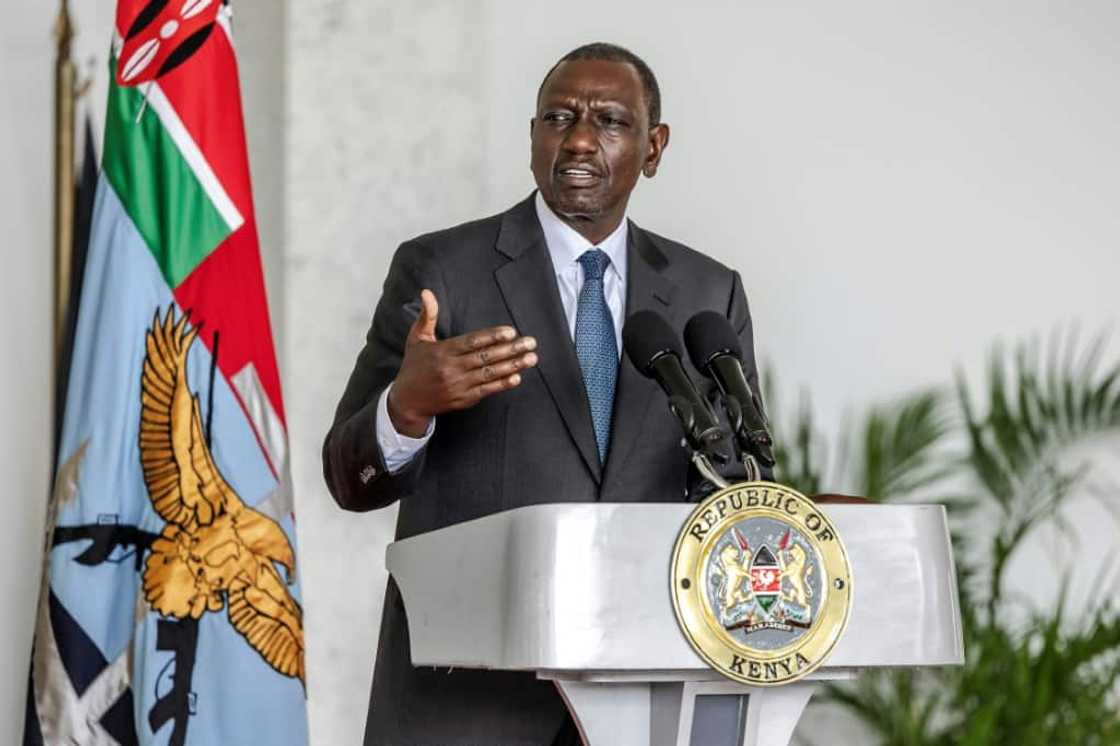
- President William Ruto has called for international cooperation and diplomatic dialogue to reduce tensions in the Middle East.
- It is recalled that the president has adopted a neutral diplomatic position, avoiding direct criticism of the United States or Iran
- The Middle East crisis escalated following the death of Iran’s top political and religious leader during a joint US-Israeli military strike.
Kenya has called for greater international cooperation as tensions continue to rise in the Middle East.
Source: AFP
In a statement on Monday, March 2, the President William Ruto He said dialogue and international diplomacy are necessary to prevent the conflict from spreading further in the region and elsewhere.
The president maintained a neutral diplomatic stance, avoiding direct criticism of the United States or Iran.
What did Ruto say about the US-Iran war?

Instead, he encouraged international organizations and international partners to lead peace talks and reduce hostilities.
Ruto warned that continued fighting could disrupt international economic systems, international security arrangements and humanitarian stability.
According to the Kenyan leadership, the escalation of the regional conflict is very worrying.
“Kenya strongly condemns the strike by the UAE, Qatar, Saudi Arabia, Iraq, Oman, Kuwait, Jordan and Bahrain in the ongoing conflict in the Middle East…Kenya wants the immediate participation of various stakeholders to slow down the pace,” Ruto said.
Several countries in the Gulf region have already reported damage to infrastructure after missile and drone activity intensified following retaliatory strikes.
Was Ayatollah Ali Khamenei killed in the US-Iran war?
The conflict escalated after Iran’s supreme leader, Ayatollah Ali Khamenei, was killed during air and military strikes coordinated by US and Israeli forces.
The operation targeted what Western military officials described as strategic military and nuclear facilities inside Iran.

Following the attack, Iran quickly responded with missile and drone strikes targeting military bases believed to house US and allied forces in the Middle East.
The Iranian authorities planned the strikes as a revenge operation and accused the Western powers of inciting larger regional conflicts.
Iranian President Masoud Pezeshkian described the incident as an attack on the entire Muslim world. At the same time, Iran’s foreign affairs leadership insisted that neighboring Gulf countries were not direct targets.
Officials said that Iran’s attacks were aimed at the presence of foreign forces in those countries rather than the countries themselves.
Despite these claims, several Gulf states have reported damage to civilian infrastructure caused by missile debris intercepted during air defense operations.
Inside Iran, political uncertainty has also increased. The authorities have formed an interim governing council to oversee government affairs while the constitutional process to elect a new chief executive begins.
Are the Kenyan police ready to fight in the US-Israeli war?

In a similar statement, the National Police Service (NPS) has denied social media claims that the Kenyan police are ready to join the ongoing conflict between the United States, Israel and Iran.
The NPS said the message claiming the Inspector General had assured Kenyans of security and readiness for war did not come through official channels.
Read ENGLISH VERSION
Do you have an exciting story that you would like us to publish? Please contact us via news@tuko.co.ke or WhatsApp: 0732482690.
Source: TUKO.co.ke