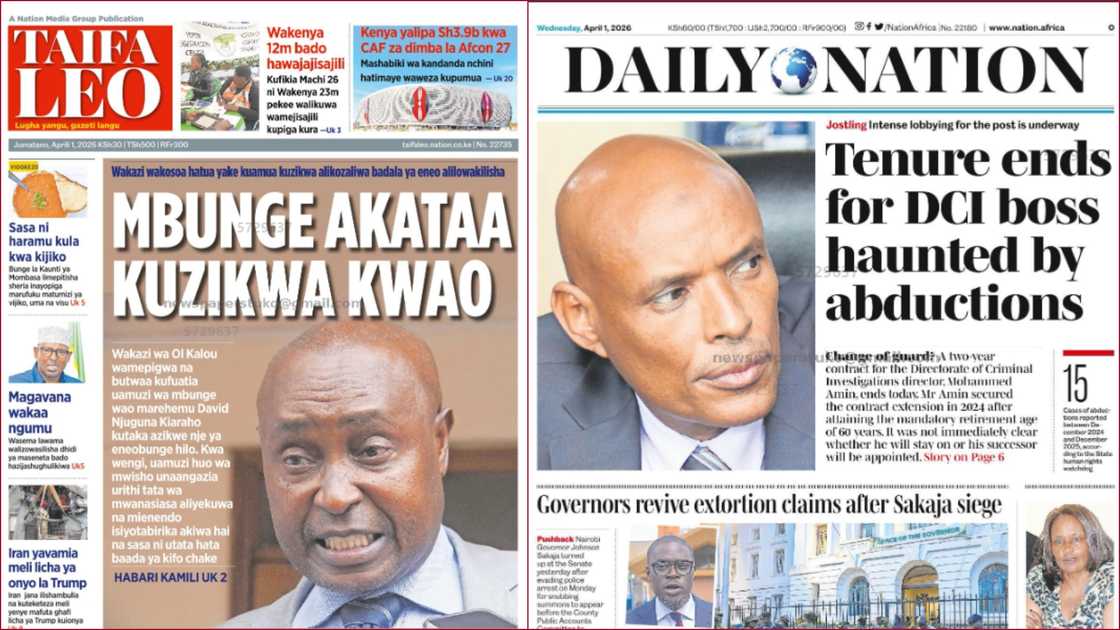





On Wednesday, November 26, local newspapers reported on intense preparations for the next by-election, with the Independent Electoral and Boundaries Commission (IEBC) assuring voters that it is fully prepared for this by-election.
Source: UGC
1. Daily Nation
These newspapers report that the broad government established by President William Ruto and Raila Odinga it is mired in great tension, due to conflicting expectations, mixed messages, and strong warnings from leaders on all sides.
What began as an effort to pacify the nation after last year’s Gen-Z protests is now struggling to maintain unity, as public promises clash with secret mistrust.
The tension has been building for months and erupted during the Kasipul by-election, where ODM leaders accused the UDA alliance of supporting an independent candidate against ODM’s Boyd Were.
Member of Parliament for Homa Bay Town, Peter Kaluma, said the mixed message confuses voters and weakens unity.
The Senate Majority Leader, Aaron Cheruiyot, later came forward, insisting that the UDA is supporting the ODM candidate and rejecting those who oppose the agreement.

But Kasipul is only one stumbling block in this partnership, as the Secretary General of ODM, Edwin Sifunahe also claimed that some of Ruto’s politicians are planning to remove him.
He criticized the value of the 10-point agreement between ODM and UDA, saying the abduction and killing of youths continues despite the agreement.
Meanwhile, UDA hardliners have drawn clear lines about the 2027 succession.
Nandi Senator, Samson Cherargeiannounced that the presidency and vice presidency have never been discussed and made it clear that Prof. Kithure Kindiki is the only acceptable one.
His statement contradicted ODM voices fighting for the position of deputy president, including Siaya senator and ODM leader Oburu Oginga.
The ODM@20 celebrations in Mombasa opened up a big ideological divide, with the governor of Siaya, James Orengo, warning that ODM will not be tied to the government.
Orengo emphasized that the Orange party must remain strong and confront the government when necessary.
He claimed that Ruto needs ODM more than ODM needs Ruto. Member of Parliament for Embakasi East, Babu Owino, expressed his anger, calling for action to be taken on the cost of living and mobilizing public protests.

2. The Star
This magazine reported that the life of Beryl Odinga, the brave woman who was the first black mayor in Zimbabwe, carried a history of pain that remained behind her public achievements.
His family confirmed he died on Monday at Nairobi West Hospital, just one month after the death of his brother, Raila Odinga.
In the memorial, Ruth’s sister said the family was mourning a woman who touched the lives of many but who recovered believing that she has now found peace.
“Although we are deeply saddened by his death and the great void he left in our lives, we find comfort in the belief that he is safe in the hands of the Lord and we are grateful for the precious gift of the time we had to work with him and for the great impact he left on all who knew him,” said Ruth.
Beryl’s journey, as described in Raila Odinga’s memoir Flames of Freedomdepicts the painful years associated with her marriage to businessman and politician Otieno Ambala.
Their relationship began shortly after graduating from high school in 1972, despite the family’s fear that Ambala had more political interests than true love.

Those fears were confirmed when Ambala ventured into politics as a Member of Parliament for Gem and an assistant minister, while their marriage deteriorated to the point of falling into the hands of Bomani abuses.
Raila writes that Beryl eventually ran away from their home, but Ambala pursued her fiercely.
While he sought safety in Zimbabwe in 1980, his peace did not last long.
Ambala followed Harare and applied Kenyan laws that required the husband’s consent for a woman to hold a passport.
Her complaints to immigration authorities left Beryl stateless and vulnerable.
A Zimbabwean court later awarded him custody of their children, saying he had no legal documents.
The memoir describes how the oppression of Ambala escalated until Beryl was forced to return to Kenya without her children.
Raila, calmly, worked through regional friends to help him get a Ugandan diplomatic passport.
Going through a secret route through Dar es Salaam, Beryl returned to Zimbabwe without being taken into the hands of Ambala for the first time.
In Harare, he built a new life, became a citizen, and became the first black mayor of Mutare, a position that kept his legacy away from the pain he fled.
3. Nation Today

The Kiswahili newspaper reports that the Kenya National Army (KDF) has suffered a major blow after the High Court agreed to a decision that found the soldiers guilty of discriminating against the soldiers based on their HIV status.
The court rejected the appeal of the Attorney General, the Ministry of Defense and the KDF, confirming the decision of July 2024 which gave the person known as PKJ 1 million shillings.
PKJ’s problem started in December 2021 during the recruitment exercise, where he was subjected to HIV tests without his consent. He said the officers announced his condition in front of other employees and asked him to “seek treatment” instead of continuing with training.
This happened despite the fact that he was already medically accepted and given an official letter to join the Eldoret Recruits’ Training School.
The government claimed that the case should be at the Employment and Labor Relations Court, insisting that it is an employment dispute.
But the judge ruled that this matter falls under the AIDS Prevention and Control Act, noting that the main problem was the way KDF officials handled the subject’s medical information, not the work conditions.
The court also rejected the allegation that the panel had avoided ordering KDF through its recruitment procedures.

There is no evidence that PKJ accepted HIV tests or was given the necessary legal advice. After the appeal is rejected, the KDF must pay compensation and implement the ordered reforms.
4. The Standard
A high-pressure legal case is underway at the International Criminal Court (ICC) after the lawyers of thousands of victims of the alleged post-election killings in Tanzania filed an appeal seeking to be brought to trial. Samia Solution Hassan and senior security officers.
The appeal, filed November 13 by Madrid lawyer Juan Carlos Gutiérrez, accuses the officers of crimes against humanity under Article 15(2) of the Rome Statute.
Although the ICC has yet to announce whether it will accept the appeal, the details paint a grim picture of widespread violence during and after the October 2025 presidential election.
According to the documents, Samia, security chiefs, senior police officers, and army generals are responsible for the killings that have continued throughout Tanzania.
The appeal indicates that they knew the security forces were targeting civilians and encouraged violence or failed to prevent it. It also mentions Samia’s public statements that are supposed to help us justify the brutality.
The brutality was organized as a government policy, including the shutdown of the Internet in accordance with the TCRA, shutting down communications and enabling mass killings.

Pan-African activists estimate more than 3,000 deaths, while diplomatic sources estimate more than 500 deaths.
Violence covered almost every major region, including Dar es Salaam, Mwanza, Arusha, Shinyanga, Morogoro, Dodoma, Mara, Songwe, Pwani, Mtwara, Ngorongoro and Loliondo.
Maasai communities were particularly affected, facing what the appeal describes as systemic abuse.
The October 29 night curfew preceded nationwide deployments of security forces, roadblocks, arrests, torture and extrajudicial killings.
Read ENGLISH VERSION
Do you have an exciting story that you would like us to publish? Please contact us via news@tuko.co.ke or WhatsApp: 0732482690.
Source: TUKO.co.ke