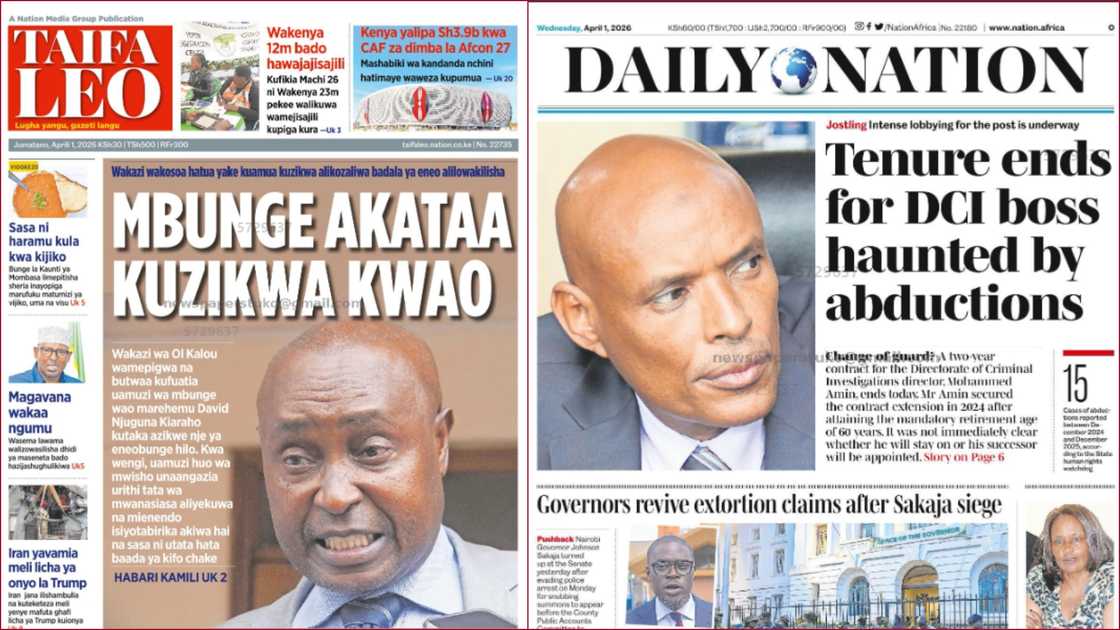




On Saturday, October 4, the daily newspapers focused on increasing tensions within united opposition, with senior leaders exchanging public criticism while at the same time emphasizing the need for unity, and exposing a major division that threatens the union’s solidarity.
Source: UGC
1. Saturday Nation
According to a daily newspaper, the opposition coalition intends to take away the president William Ruto In 2027, it shows preliminary signs of tension as internal divisions and personal conflicts arise.
The essence of the crash is the role of the President’s Jubilee party Uhuru Kenyatta.
Former deputy president Rigathi Gachagua He has ignored the “council politics,” emphasizing the presidential success is based on the mobilization of local people, with former Internal Security Minister Fred Matiang’i defending his position with the Jubilee as a democratic and participatory choice.
Gachagua has challenged Matiang’i to build his stronghold Kisii, pretending to be a true opponent of the union, with critics criticizing him for negotiating with Ruto to get a vote, a claim he denies.
Meanwhile, Matiang’i emphasized patience and political maturity, noting how the Jubilee continues to make the adjustment and cooperation of the youth before the 2027 elections.
He wanted the youth to register to vote and take up leadership positions within the party, and set it up as a youth -driven movement.
Political analysts suggested a riot of opposition to benefit Ruto, who shows the image of the organization’s discipline, while the parties within the coalition, including the DCP, Wiper, People’s Liberation Party, and Dap-Kenya, endanger many years of internal disputes about the presidential ticket.
The tension was manifested at an opposition summit in Kajiado, where Gachagua, Musyoka, Eugene Wamalwaand Justin Muturi supported the DCP candidates in the upcoming elections and vowed to hold Ruto for alleged murder and corruption if they won 2027.
Community complaints, including land abuse in Kajiado, were highlighted as main motivated arguments.
2. Saturday Standard
According to the newspaper, Deputy Inspector General of Police Eliud Lagat is facing an investigation into allegations of millions of dollars allocated to officers sent during the recent Chan competition.
Younger officials claim that they have not yet received allowances, while others report payments under the written amount.
KSh11 million was allocated for each payment, with senior officials as Director of Operations Adamson Parliament expected to secure KSh258,000 for the 28 -day competition, with a police constituency scheduled for KSh97,020. Some officials, however, say they received a small amount of KSh10,000, which raised concerns about abuse.
Efforts to get IG Douglas Kanja, Dig Lagat, and Interior Minister Kipchumba Murkomen to make their comments were not answered.
The chief police officer denied the allegations and said rumors, claiming that food and equipment were charged.
The Local Organizing Committee (LOC) explained that the allowances were transferred to the Police Force in the country, not directly dealt with by the committee.
Officials expressed frustration and delay in charging violations, noting that the vouchers and deployment plans showed much more.
The use of oil, which is reported to be a total of Ksh50 million, also sparked accusations, with some officials spending more operating costs than the allowances they received.
Although some senior officers accepted the quietly reduced payments, the lower positions are left unpaid.
Observers say Lagat, as head of operation, carries the direct responsibility of managing sending and payment.
3. Nation today
According to the Swahili journal, more than 3.4 million students are expected to start national examinations from October 17, 2025, marking the largest cycle of examinations in Kenya’s history and putting pressure on education and security systems.
The schedule introduces the Kenya Youth Youth Education (KJSEA) Education Education for Class 9 under the CEO’s Curriculum Curriculum (CBE), and 1,130,669 students have been registered.
In addition, 996,078 students will graduate from the Kenya Secondary Education Certificate (KCSE), with 1,298,089 candidates preparing for a 6 KPSEA class assessment.
KNEC has added examination containers from 617 to 642 to ensure timely delivery.
Thousands of security officers will be sent to protect exams, manage transportation, and maintain stability at centers.
For KCSE alone, there will be 12,126 chief inspectors, 54,782 observers, 10,765 stations managers, 2,692 drivers and 22,247 security officers.
For KPSEA and KJSEA, a larger number is given, while security is placed in high -risk areas.
To prevent fraud, the exams will have student names and numbers, and the papers will be signed, set the date, and closed in a special envelope.
KNEC will also test the 250 electronic locks.
The government has allocated KSh 950 million to train teachers for the effective implementation of the CBE, ensuring that students and staff are prepared for this historic cycle of examinations.
4. PD weekend
According to the post, Auditor General Nancy Gathungu reported significant financial misconduct at 141 hospitals, amid KSh 7.7 billion total flaws.
The audit noted unused expenditures, differences that have not been resolved, and cash errors and proportions with cash, showing systemic weaknesses in financial management and administration in 4, 5 and 6 hospitals.
The report reveals that 37% of hospitals failed to submit financial statements, with many lacking auditory committees or internal audit units.
Only non -supported expenditure reached KSh 2.64 billion in 65 hospitals, contrary to public financial management regulations. The main hospitals involved include Makueni County Referral Hospital (KSh 424.5 million), JM Kariuki Memorial Hospital (KSh 337.3 million), Pumwani Parent Hospital (KSh 280 million), and Njoro County Hospital (KSh 214.2 million).
Small institutions also reported a small error, ranging from KSh 21,000 to KSh 150,000.
The unresolved differences affected 139 hospitals, a total of KSh 11.7 billion, while other challenges include poor income reports, delay in payment, universal health insurance badly managed by community health insurance claims, and spending without proper documentation.
The audit emphasized the failure of good governance, poor financial systems, and weak internal control, which prevents the provision of quality services and endangering public resources.
Gathungu’s report called for immediate measures to strengthen financial management, to ensure accountability, and to protect public funds in the Kenyan health sector.
Read English version
Do you have an exciting information that you would like to publish? Please, contact us via news@tuko.co.ke or WhatsApp: 0732482690.
Source: TUKO.co.ke