






Kenya has ramped up its environmental diplomacy with a renewed push for global consensus on plastic pollution following high-level talks between Ambassador Ababu Namwamba, EGH, and top officials from the Danish Ministry of Environment.
On Friday, July 4, Namwamba—Kenya’s Permanent Representative to the United Nations Office at Nairobi (UNON) and UNEP—announced via X that he had held key discussions with Denmark’s Sidsel Bijol, Director of the International Office, and Martha Meilstrup, Denmark’s lead on plastics and microplastics pollution negotiations.
“Held fruitful talks with Sidsel Bijol, Director of the International Office of the Danish Ministry of Environment, and Martha Meilstrup,” part of the post read.
The meeting, held in Nairobi, came just days after Denmark assumed the rotating presidency of the European Union on July 1. It focused on aligning positions ahead of two critical events: the Intergovernmental Negotiating Committee (INC5.2) on plastic pollution in Geneva (August 5–14) and the United Nations Environment Assembly (UNEA-7), set for Nairobi in December.
“The focal point for the ongoing plastics and microplastics pollution negotiations. We explored common areas of interest towards the INC5.2 negotiations in Geneva and UNEA7 in Nairobi. We are both committed to building consensus,” part of the post read.
Photos shared from the engagement captured a diplomatic yet collaborative atmosphere—handshakes, seated discussions over documents and laptops, and a group photo symbolising a united front in environmental stewardship.
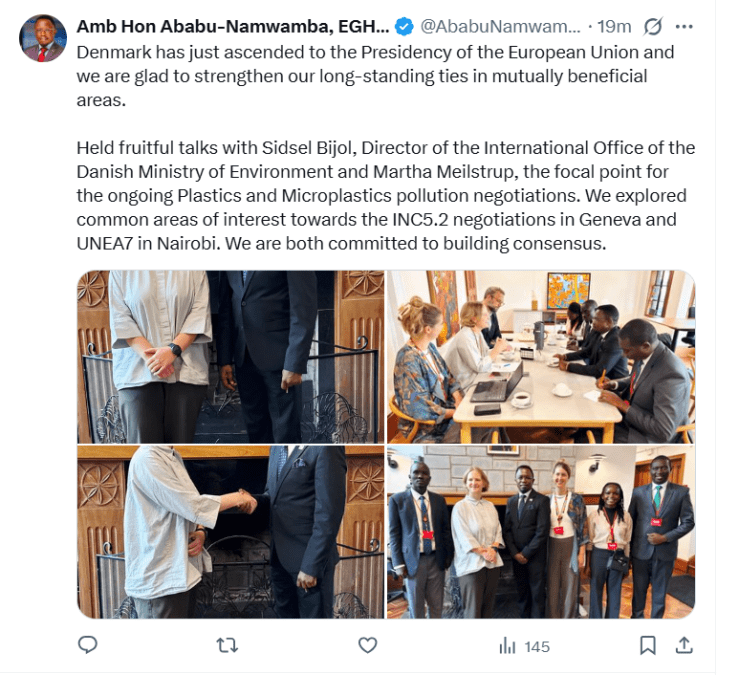
Namwamba posted, highlighting the significance of shared environmental objectives and stronger bilateral ties.
At the heart of the talks was the global plastic crisis. Microplastics, now detected even in deep-sea ecosystems, are estimated to account for up to 5% of oceanic carbon—statistics likely central to the day’s discussion.
Namwamba, who transitioned to his UN role in January 2025 after serving as Cabinet Secretary for Youth Affairs, Sports, and Arts, brought a strong policy background and a track record in advocacy. His engagement with Bijol and Meilstrup underscored Kenya’s leadership in environmental diplomacy and its readiness to shape negotiations from a continental perspective.
Denmark’s participation comes against the backdrop of its widely acclaimed Green Tripartite Agreement on agricultural emissions—an example of consensus-driven policy that may influence international talks on plastic regulation.
With UNEP headquartered in Nairobi and UNEA-7 fast approaching, the meeting served as a strategic moment for Kenya to assert its position not just as a host, but as a thought leader on climate and sustainability.
As the session wrapped up, both delegations reaffirmed their commitment to building consensus ahead of INC5.2 and UNEA-7, setting the stage for deeper Kenya-Denmark cooperation in pursuit of a cleaner, more sustainable planet.