






Lawyer Willis Otieno has issued a powerful rebuke of recent police actions, warning that the increasing militarisation of law enforcement risks turning the state into an instrument of repression rather than a guardian of public trust.
In a statement on his official account on Sunday, June 29, 2025, sharply critical of the government’s use of force against its citizens, Otieno called on the state to uphold constitutional and international standards on police conduct, emphasising that public trust—not firepower—forms the true foundation of legitimate governance.
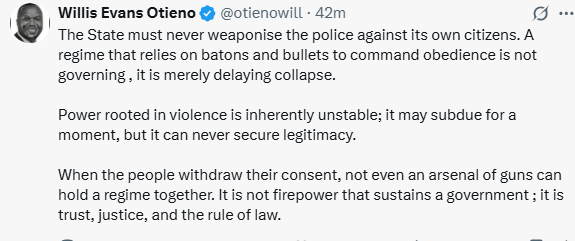
“The state must never weaponise the police against its citizens,” Otieno said.
“A regime that relies on batons and bullets to command obedience is not governing; it is merely delaying collapse.”
Otieno’s remarks come in the wake of rising public concern over alleged extrajudicial killings, excessive use of force during protests, and the growing presence of armed police in civilian matters.
From Kenyan law and international standards, Otieno underscored the legal boundaries within which security operations must operate.
“Article 238(2)(b) of our Constitution is clear,” he noted. “National security shall be pursued in compliance with the law and with the utmost respect for the rule of law, democracy, human rights, and fundamental freedoms.”
According to Otieno, this legal foundation requires that all police operations be carried out within a strict, rights-based framework. He cited the National Police Service Act, 2011 (Revised 2023), which only permits the use of firearms under very specific and limited conditions.
Section B(1) of the Sixth Schedule clearly states that firearms may be used only in self-defence or defence of others against the imminent threat of death or serious injury, to prevent a grave crime involving a grave threat to life, to arrest a person presenting such a danger and resisting the officer’s authority, or to prevent the escape of such a person.
“These are not just guidelines—they are binding legal limits,” Otieno emphasised. “Power rooted in violence is inherently unstable; it may subdue for a moment, but it can never secure legitimacy.”
He reminded law enforcement agencies of their obligations under the National Police Service (Use of Force) Standing Orders.
Due process
These rules mandate that officers must attempt non-violent means first, provide a warning before using force or firearms, offer medical assistance to those injured, and report and account for any use of firearms.
The legal requirements mirror the international norms to which Kenya is bound, including the United Nations Basic Principles on the Use of Force and Firearms by Law Enforcement Officials (1990). These standards stipulate that firearms should be used only as a last resort and solely in self-defence or in defence of others from an imminent threat of death or serious injury.
Otieno warned that ignoring these safeguards risks alienating the very citizens the police are sworn to protect.
“When the people withdraw their consent, not even an arsenal of guns can hold a regime together. It is not firepower that sustains a government; it is trust, justice, and the rule of law,” he said.
He emphasized that the statement serves as a call to action for policymakers, the National Police Service, and the broader public to demand accountability and uphold democratic values.
Civic groups and human rights organisations have echoed Otieno’s sentiments, urging the Independent Policing Oversight Authority (IPOA) to expedite investigations into reported abuses and to ensure officers are held accountable for unlawful use of force.
He said as Kenya grapples with the balance between national security and civil liberties, the message should be a stark reminder that lasting peace and stability cannot be achieved through coercion.
“A government that rules through violence is not ruling at all. It is simply borrowing time from an inevitable reckoning,” he asserted.