





Kenyan socialite and beauty entrepreneur Huddah Monroe has spoken out about the country’s worsening economic conditions, expressing deep frustration at the hardships facing young people.
Her comments come as Kenya continues to witness powerful youth-led anti-government protests that have now lasted for over a year.
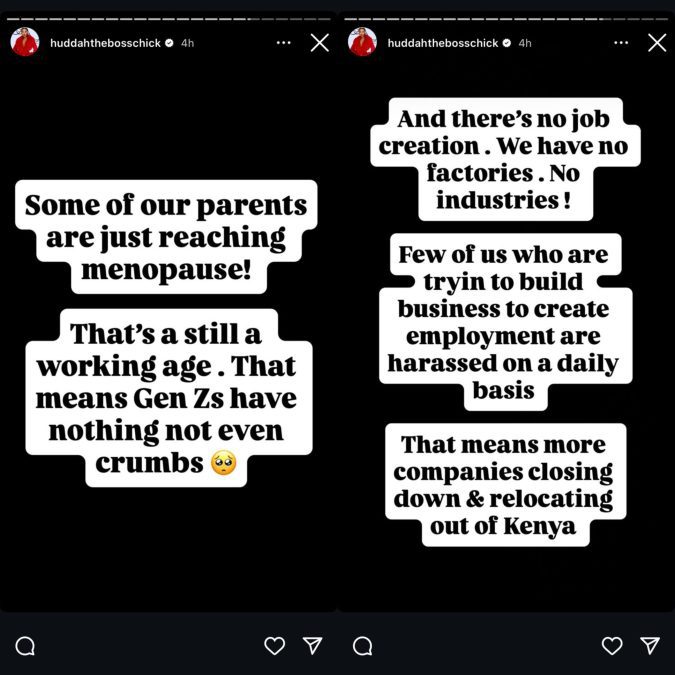
In a series of Instagram stories shared on Thursday, June 26, 2025, Huddah reflected on the struggles of an entire generation caught in what she described as a cycle of economic pain and government neglect.
She noted that Kenya is witnessing a rare moment where three generations of parents, millennials, and Gen Z are all battling just to survive.
According to Huddah, many parents are still of working age, some only now reaching menopause, yet their children are struggling to find any opportunities. She pointed to the lack of jobs, the lack of industries, and a government that seems to stifle, rather than support, those trying to build businesses.
She lamented that few who attempt to create employment opportunities face daily harassment, leading to businesses shutting down or relocating outside the country.
“We have like 3 generations fighting for a living in Kenya. Our parents (most are not old), millennials and now Gen Z. Some of our parents are just reaching menopause! That’s still a working age. That means Gen Zs have nothing, not even crumbs. And there’s no job creation. We have no factories. No industries! Few of us who are trying to build a business to create employment are harassed daily. That means more companies closing down & relocating out of Kenya,” Huddah stated.
Her message painted a bleak picture of a system that is failing its people. She ended one of her posts with a powerful quote from philosopher Jean-Jacques Rousseau: “When the people shall have nothing more to eat, they will eat the rich.”
Frustrated citizens
Huddah’s comments echo the frustrations felt by many young Kenyans who have been protesting since June 2024. What began as a protest against the proposed Finance Bill, which included painful tax hikes on essentials, has since evolved into a broader youth-led movement demanding deep reforms in governance, justice, and economic opportunities.
The first wave of protests in mid-June 2024 saw thousands, mostly youth, pour into the streets. On June 25, demonstrators stormed Parliament in Nairobi. The government responded with live bullets and tear gas, leading to multiple deaths, hundreds injured, and many arrested.
The next day, under immense public pressure, President William Ruto withdrew the Finance Bill.
Gen Z and millennials used social media to keep the momentum going, mobilising in waves through decentralised protests and online campaigns calling for President Ruto to resign.
Tensions flared again in June 2025 after the death of blogger Albert Ojwang while in police custody. His death on June 6, 2025, sparked fresh anger, leading to renewed calls for accountability.
On June 25, 2025, the first anniversary of the storming of Parliament, massive demonstrations broke out again across major cities, including Nairobi, Mombasa, Eldoret, and Nakuru. Thousands marched to honour those killed a year earlier and to once again demand an end to police violence and corruption.
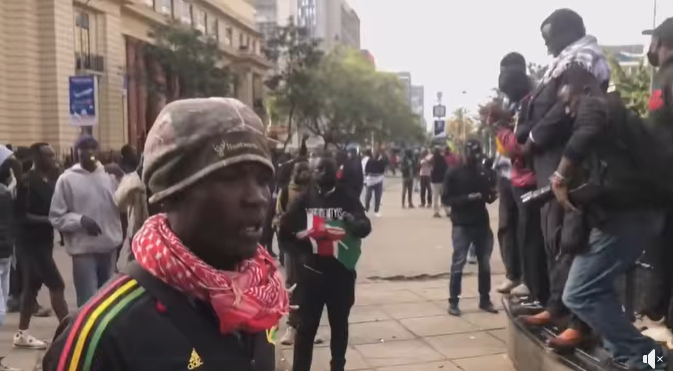
That day ended in bloodshed. At least eight people were killed, hundreds injured, and over 400 wounded across the country as police responded with live ammunition, tear gas, water cannons, and mass arrests.
The government moved to block coverage of the protests. Live media broadcasts were banned and shut down. Despite the blackout, protesters continued to document police violence and coordinate actions online, using social media as a tool for resistance.