



/X
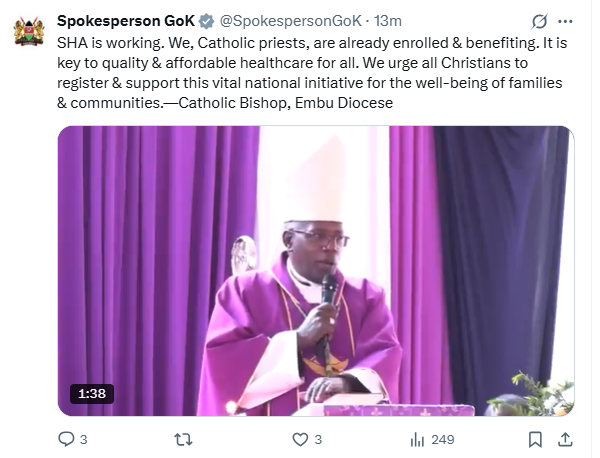
Catholic bishops have declared their firm support for the government’s Social Health Authority (SHA), calling it a crucial step toward delivering affordable and accessible healthcare to every Kenyan.
Speaking on Sunday, June 22, 2025, Catholic Bishop of the Embu Diocese, Peter Kimani Ndung’u, affirmed that priests and church institutions are already enrolled in the SHA system and are beginning to benefit.
He urged all Christians to follow suit, describing the initiative as a moral imperative and a matter of public justice.
“SHA is working. We, Catholic priests, are already enrolled and benefiting,” Bishop Ndu’ngu said during a diocesan health outreach event.
“It is key to quality and affordable healthcare for all, and we urge all Christians to register and support this vital national initiative for the well-being of families and communities.”
The Social Health Authority, launched on October 1, 2024, as a replacement for the National Health Insurance Fund (NHIF), is designed to centralise and streamline healthcare access for all Kenyans under one digital framework. While its implementation has faced logistical teething issues, church leaders believe the long-term benefits outweigh the current challenges.
“Access to healthcare is not a privilege; it is a human right,” he said.
“The SHA aligns with the Church’s social teaching, especially the principle of the common good. We cannot turn a blind eye when a mother cannot afford to take her child to the hospital or when the elderly suffer in silence because of medical bills.”
Church’s voice
The bishop’s endorsement comes at a delicate time for the Catholic Church in Kenya. While supportive of SHA’s objectives, the Kenya Conference of Catholic Bishops (KCCB) has been increasingly vocal about what it sees as deteriorating governance under President Ruto.
“We support the SHA, yes. But this support must not be interpreted as silence on other pressing issues,” the bishop clarified.
“We remain deeply troubled by recent killings — some of which bear signs of state involvement — and the lack of transparency in how public affairs are being managed. You cannot build trust in one sector while eroding it in others.”
The dual message underscores a growing tension within church-state relations in Kenya: strong support for essential public services like health, education, and food security — but also a call for accountability, respect for life, and ethical leadership.
Ndu’ngu also noted that the Catholic Church’s network of mission hospitals and health facilities is ready to integrate with SHA systems, provided that the process remains transparent and inclusive.
“We have over 500 Catholic health facilities across the country,” he said.
“We are already working closely with county health departments and the national Ministry of Health. If SHA is properly managed, it will strengthen—not replace—these community health structures.”
He said Kenyans across the country have expressed a mix of hope and scepticism regarding the SHA rollout. For many, past failures of NHIF and other state-run medical schemes remain fresh in their minds. But church support could offer a significant trust boost for the programme, especially in rural and faith-driven communities.
“We urge the faithful not to be misled by political confusion. Good initiatives must be supported, even as we continue to hold our leaders to account. It is not contradictory to support healthcare reform and still demand justice, truth, and ethical governance,” he asserted.