






The Kenya Meteorological Department has issued an alert warning residents in parts of the Coast, South-eastern, North-eastern and North-western Kenya to brace for strong winds over the week starting Tuesday, June 17, 2025.
In its weekly weather forecast released on Tuesday morning, the Met Department noted that southerly to south-easterly winds exceeding 25 knots (approximately 12.86 metres per second) are expected to sweep across the affected regions, including Kenya’s territorial waters.
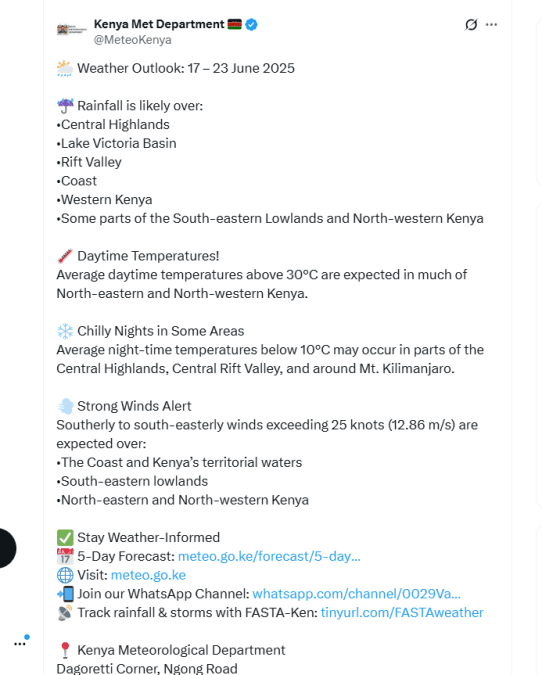
“Strong Winds Alert. Southerly to south-easterly winds exceeding 25 knots (12.86 m/s) are expected over the coast and Kenya’s territorial waters, the southeastern lowlands, and northeastern and northwestern Kenya. Stay Weather-Informed,” Kenya Met said.
According to the advisory, these winds could pose a danger to maritime activities, light aircraft operations, and road users in exposed areas, particularly those in the semi-arid and coastal lowlands.
The department urged fishermen, small boat operators, and residents in the affected regions to exercise heightened caution and stay updated with ongoing advisories.
Persistent rainfall
Alongside the wind alert, the Met Department also highlighted that rainfall is likely to persist in several parts of the country, including the Central Highlands, Lake Victoria Basin, Rift Valley, Western Kenya, Coast, and isolated areas in the South-eastern Lowlands and North-western Kenya.
“Average nighttime temperatures below 10°C may occur in parts of the Central Highlands, Central Rift Valley, and around Mt Kilimanjaro.”
In terms of temperature, daytime highs exceeding 30°C are expected in many parts of northeastern and northwestern Kenya, while nighttime lows below 10°C may occur in the Central Highlands, Central Rift Valley, and areas around Mt Kilimanjaro.
“Daytime Temperatures! Average daytime temperatures above 30°C are expected in much of northeastern and northwestern Kenya.”
Residents across the country have been advised to prepare adequately, especially those in regions prone to weather-related risks.
The Met Department reiterated its commitment to providing timely and accurate weather information to support safety, planning, and climate resilience.
Previous week’s forecast
The forecast follows hot on the heels of a previous advisory in which the department had issued a 7-day outlook from June 10, 2025, to June 16, 2025, cautioning of sharply contrasting weather patterns across the country.
In a post shared by the department on their official X account, dated June 10, 2025, they noted that while the Central Highlands, Lake Victoria Basin, Rift Valley, Coast, and Western Kenya brace for persistent rainfall, the Coast and northern Kenya will endure scorching daytime temperatures exceeding 30°C.
“Central Highlands, Lake Victoria Basin, Rift Valley, Coast, and Western Kenya brace for persistent rainfall, while the Coast and northern Kenya will endure scorching daytime temperatures exceeding 30°C,” read a post in their official X account.

According to KMD, cumulative rainfall was expected to surpass 100 mm in the Central Highlands and Lake Victoria Basin, with moderate showers in the Rift Valley and coastal areas.
Meanwhile, the coast and arid northeastern and northwestern regions were warned of intense heat.
The KMD’s temperature map showed that maximum daytime temperatures would climb above 30°C, signalling potential health and agricultural challenges in these hot zones.
The coastal areas were simultaneously forecasted to contend with strong winds, with speeds exceeding 25 knots (about 12.86 m/s) blowing from the south to southeast.
The department emphasised the need for vigilance as these extreme weather conditions unfold.
“Communities must stay alert and take precautions to protect livelihoods and property,” KMD added.