




The budget, presented by the National Treasury, projects a total expenditure of Ksh. 4.26 trillion for the 2025/26 financial year.
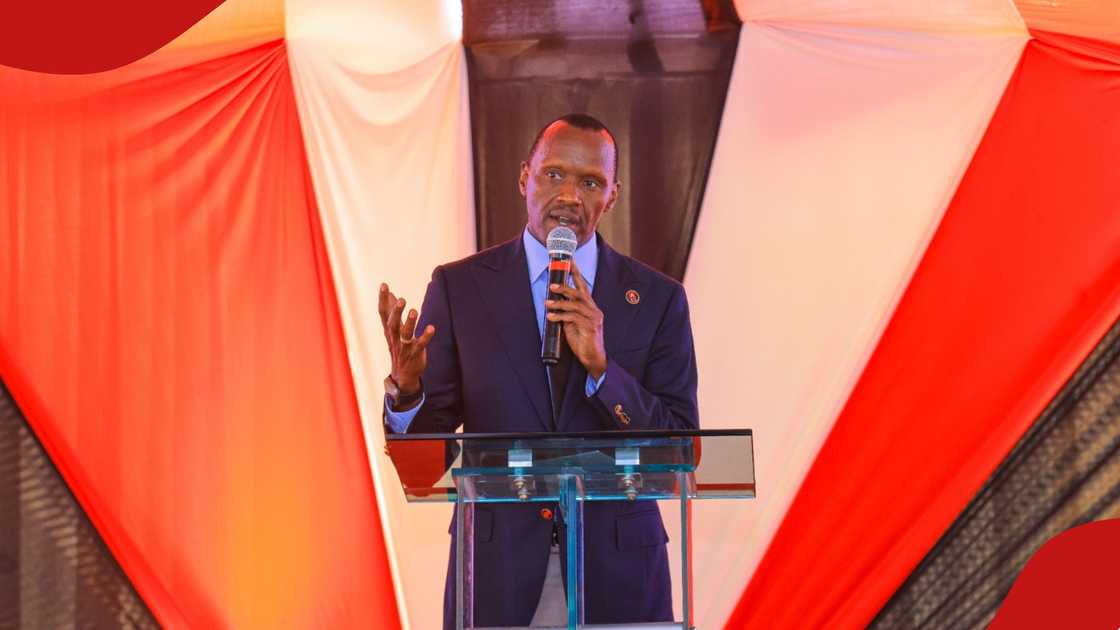
The Kenya African National Union (KANU) chairman, Gideon Moi, has criticised the Kenyan government’s proposed 2025/26 budget estimates, accusing the administration of prioritising lavish spending and surveillance over economic development and citizen welfare.
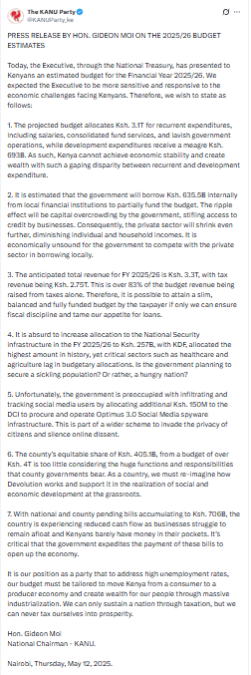
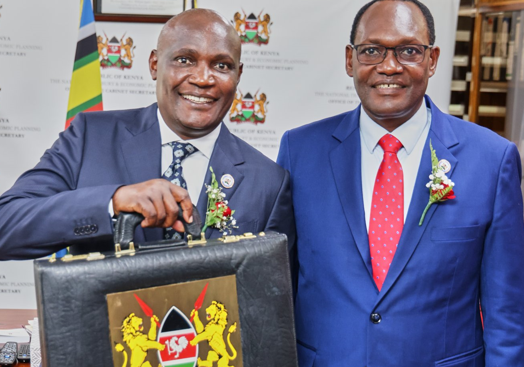
In a press release issued on Thursday, June 12, 2025, just moments after Treasury Cabinet Secretary John Mbadi unveiled his first budget in the National Assembly, Moi warned that the budget’s structural imbalances and controversial allocations could plunge the nation into economic stagnation while eroding fundamental privacy rights.

The budget, presented by Mbadi, projects a total expenditure of Ksh4.26 trillion for the 2025/26 financial year. However, Moi says the country expected the Executive to be more sensitive and responsive to the economic challenges facing Kenyans.
Disparity
The former Baringo Senator says Kenya cannot achieve economic stability and create wealth with a gaping disparity between recurrent and development expenditure, where recurrent expenditures, including salaries, consolidated fund services, and lavish government operations, are allocated Ksh3.1 trillion, while development expenditures receive a meagre Ksh693 billion.
“The projected budget allocates Ksh. 3.1T for recurrent expenditures, including salaries, consolidated fund services, and lavish government operations, while development expenditures receive a meagre Ksh. 693B. As such, Kenya cannot achieve economic stability and create wealth with such a gaping disparity between recurrent and development expenditure,” he stated.
Moi critiques borrowing
Moi further argues that the ripple effect of borrowing Ksh635.5 billion to fund the budget will be capital overcrowding by the government, stifling access to credit by businesses.
Consequently, he argues that the private sector will shrink even further, diminishing individual and household incomes. According to Moi, it is economically unsound for the government to compete with the private sector in borrowing locally.
“It is estimated that the government will borrow Ksh. 635.5B internally from local financial institutions to partially fund the budget. The ripple effect will be capital overcrowding by the government, stifling access to credit by businesses. Consequently, the private sector will shrink even further, diminishing individual and household incomes. It is economically unsound for the government to compete with the private sector in borrowing locally,” Moi stated.
“The anticipated total revenue for FY 2025/26 is Ksh. 3.3T, with tax revenue being Ksh. 2.75T. This is over 83% of the budget revenue being raised from taxes alone. Therefore, it is possible to attain a slim, balanced, and fully funded budget by the taxpayer if only we can ensure fiscal discipline and tame our appetite for loans.”
He went ahead to criticise the government for allocating more funds to the Kenya Defence Forces (KDF) as compared to the health and agricultural sectors.
“It is absurd to increase allocation to the National Security infrastructure in the FY 2025/26 to Ksh. 257B, with KDF, allocated the highest amount in history, yet critical sectors such as healthcare and agriculture lag in budgetary allocations. Is the government planning to secure a sickling population? Or rather, a hungry nation?” Moi argued.
Privacy invasion
He also accuses the government of orchestrating a scheme to invade the privacy of citizens and silence online dissent.
“Unfortunately, the government is preoccupied with infiltrating and tracking social media users by allocating additional Ksh. 150M to the DCI to procure and operate Optimus 3.0 Social Media spyware infrastructure. This is part of a wider scheme to invade the privacy of citizens and silence online dissent,” the statement read.