





Over the past few days, Kenyans online have been drawn into a discussion regarding the safety of potatoes after a report suggested that unsafe pesticide residues were found in potatoes grown in Nyandarua County.
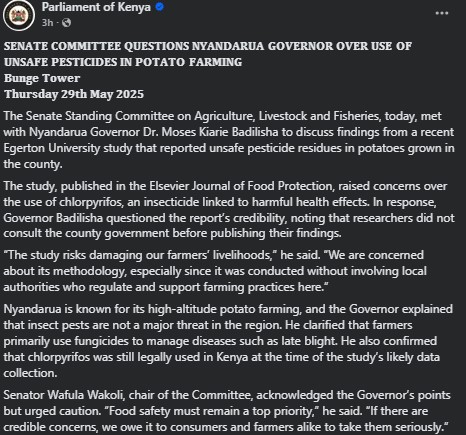
The findings from Egerton University, published in the Elsevier Journal of Food Protection, raised concerns over the use of chlorpyrifos, an insecticide linked to harmful health effects.
Moved by the concerns, senators summoned Nyandarua Governor Moses Kiarie Badilisha to shed light on the issue.
Badilisha’s response
Appearing before the Senate Standing Committee on Agriculture, Livestock and Fisheries on Thursday, May 29, 2025, Governor Badilisha questioned the report’s credibility, noting that researchers did not consult the county government before publishing their findings.
He further told the committee that the findings risk affecting the potato farming business in the county.

“The study risks damaging our farmers’ livelihoods,” he said.
“We are concerned about its methodology, especially since it was conducted without involving local authorities who regulate and support farming practices here,” he added.
Badilisha explained before the committee that Nyandarua is known for high-altitude potato farming but insisted that insect pests are not a major threat in the region.
He clarified that farmers primarily use fungicides to manage diseases such as late blight. He also confirmed that chlorpyrifos was still legally used in Kenya at the time of the study’s likely data collection.
Independent probe
After listening to Badilisha’s argument, the committee chaired by Senator Wafula Wakoli called for an independent verification of the findings.

They called on Kenya Agricultural and Livestock Research Organisation (KALRO) and national regulatory agencies such as the Pest Control Products Board (PCPB), the Kenya Plant Health Inspectorate Service (KEPHIS), and the Agricultural Advisory Committee of Kenya (AAK) to take an active role in the verification exercise.
While issuing the orders, Wakoli called for the protection of consumers.
“Food safety must remain a top priority. If there are credible concerns, we owe it to consumers and farmers alike to take them seriously,” he insisted.