





Popular Mugithi artist and police officer Samuel Muchoki, famously known as Samidoh, is among the budding writers who wanted to tap into Ngugi wa Thiong’o’s rich experience.
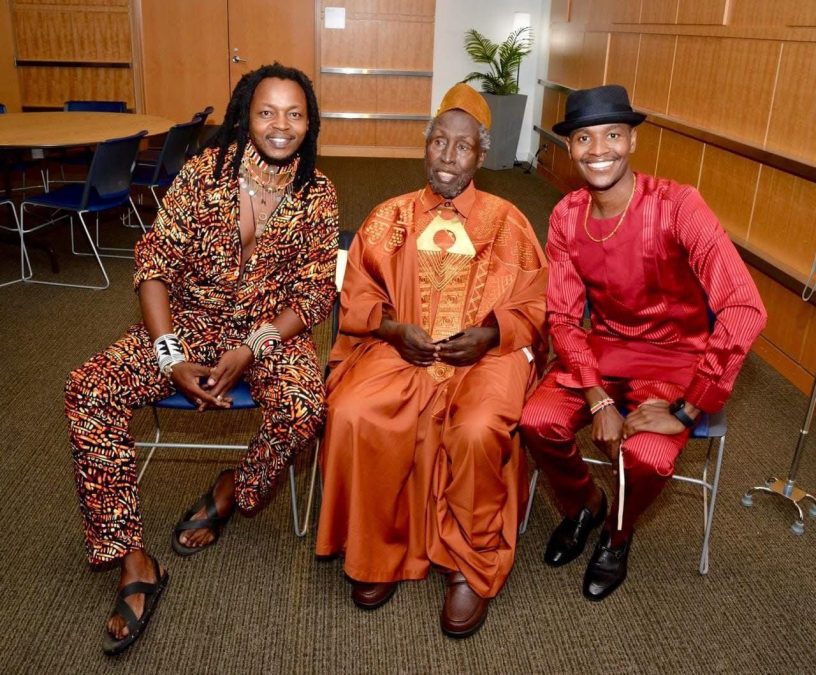
In a statement on Thursday, May 29, 2025, Samidoh revealed that he met the renowned and award-winning Kenyan author Ngũgĩ wa Thiong’o in June 2024.
Their conversation ended with a promise where Samidoh told the revered writer that he would fly back to Atlanta to seek his support in writing a book.
However, Samidoh never made it back on time until Wednesday, May 28, 2025, when his family confirmed Ngugi wa Thiong’o’s death.
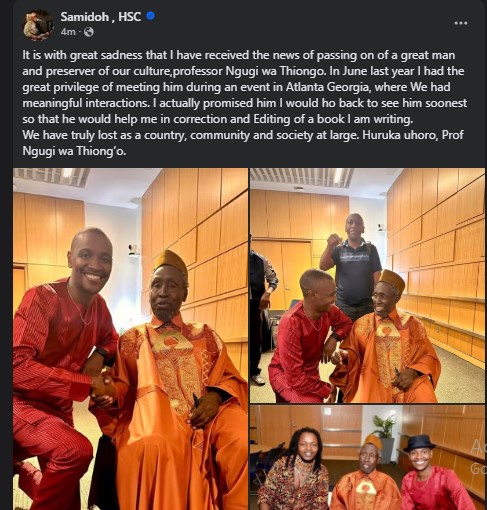
“It is with great sadness that I have received the news of the passing of a great man and preserver of our culture, Professor Ngugi wa Thiongo,” Samidoh wrote.
“In June last year, I had the great privilege of meeting him during an event in Atlanta, Georgia, where we had meaningful interactions. I actually promised him I would go back to see him soonest so that he would help me in the correction and Editing of a book I am writing,” he added.
“We have truly lost as a country, community and society at large.”
His death
Ngũgĩ wa Thiong’o was born on January 5, 1938, in Kamiriithu near Limuru in Kiambu County. He has been hailed as a prolific writer, academic, and political thinker.
On Wednesday, May 28, 2025, his daughter Wanjiku wa Ngũgĩ confirmed his demise and asked the people to celebrate his works per his last wishes.
“It is with a heavy heart that we announce the passing of our dad, Ngũgĩ wa Thiong’o, this Wednesday morning, 28th May 2025. He lived a full life, fought a good fight. As was his last wish, let’s celebrate his life and his work. Rîa ratha na rîa thŭa. Tŭrî aira!,” she wrote on Facebook.

His literary works, including ‘Weep Not, Child’ (1964), ‘The River Between’ (1965), ‘A Grain of Wheat’ (1967), ‘Petals of Blood’ (1977), and ‘Wizard of the Crow’ (2006), are celebrated for their profound exploration of Kenya’s colonial and post-colonial experiences.
In 1977, his politically charged play ‘Ngaahika Ndeenda’ (I Will Marry When I Want), co-authored with Ngũgĩ wa Mirii, led to his detention without trial by the Kenyan government.
He has since been mourned by leaders in the country and across the continent hailing his contribution to literary works.